ISO 19136-1:2020
ISO 19136-1:2020

ISO 19136-1:2020

janvier 2020
Norme internationale En vigueur

Geographic information - Geography Markup Language (GML) - Part 1: Fundamentals

The Geography Markup Language (GML) is an XML encoding in accordance with ISO 19118 for the transport and storage of geographic information modelled in accordance with the conceptual modelling framework used in the ISO 19100 series of International Standards and including both the spatial and non-spatial properties of geographic features.This document defines the XML Schema syntax, mechanisms and conventions that:— provide an open, vendor-neutral framework for the description of geospatial application schemas for the transport and storage of geographic information in XML;— allow profiles that support proper subsets of GML framework descriptive capabilities;— support the description of geospatial application schemas for specialized domains and information communities;— enable the creation and maintenance of linked geographic application schemas and datasets;— support the storage and transport of application schemas and datasets;— increase the ability of organizations to share geographic application schemas and the information they describe.Implementers can decide to store geographic application schemas and information in GML, or they can decide to convert from some other storage format on demand and use GML only for schema and data transport.NOTE If an ISO 19109 conformant application schema described in UML is used as the basis for the storage and transportation of geographic information, this document provides normative rules for the mapping of such an application schema to a GML application schema in XML Schema and, as such, to an XML encoding for data with a logical structure in accordance with the ISO 19109 conformant application schema.


Visualiser l'extrait
Informations générales

Collections

Normes internationales ISO

Date de publication

janvier 2020

Nombre de pages

358 p.

Référence

ISO 19136-1:2020

Codes ICS

35.240.70   Applications des TI dans les sciences

Numéro de tirage

1
Résumé
Geographic information - Geography Markup Language (GML) - Part 1: Fundamentals

The Geography Markup Language (GML) is an XML encoding in accordance with ISO 19118 for the transport and storage of geographic information modelled in accordance with the conceptual modelling framework used in the ISO 19100 series of International Standards and including both the spatial and non-spatial properties of geographic features.

This document defines the XML Schema syntax, mechanisms and conventions that:

— provide an open, vendor-neutral framework for the description of geospatial application schemas for the transport and storage of geographic information in XML;

— allow profiles that support proper subsets of GML framework descriptive capabilities;

— support the description of geospatial application schemas for specialized domains and information communities;

— enable the creation and maintenance of linked geographic application schemas and datasets;

— support the storage and transport of application schemas and datasets;

— increase the ability of organizations to share geographic application schemas and the information they describe.

Implementers can decide to store geographic application schemas and information in GML, or they can decide to convert from some other storage format on demand and use GML only for schema and data transport.

NOTE If an ISO 19109 conformant application schema described in UML is used as the basis for the storage and transportation of geographic information, this document provides normative rules for the mapping of such an application schema to a GML application schema in XML Schema and, as such, to an XML encoding for data with a logical structure in accordance with the ISO 19109 conformant application schema.
Normes remplacées (1)
ISO 19136:2007
ISO 19136:2007
septembre 2007
Norme internationale Annulée
Information géographique - Langage de balisage en géographie (GML)

Le langage GML (Geography Markup Language, langage de balisage en géographie) est un codage XML conforme à l'ISO 19118 pour le transport et le stockage des informations géographiques modélisées conformément au cadre de modélisation conceptuelle utilisé dans la série de Normes internationales ISO 19100 et comprenant les propriétés spatiales et non spatiales des entités géographiques. L'ISO 19136:2007 définit la syntaxe, les mécanismes et les conventions du schéma XML qui offrent un cadre ouvert indépendant du fournisseur pour la description des schémas d'application géospatiale pour le transport et le stockage des informations géographiques en langage XML; autorisent les profils prenant en charge les sous-ensembles corrects de possibilités descriptives du cadre GML; prennent en charge la description des schémas d'application géospatiale pour les domaines et communautés d'informations spécialisés; permettent de créer et d'entretenir des schémas d'application géographique associés et des ensembles de données; prennent en charge le stockage et le transport des schémas d'application et des ensembles de données; augmentent les possibilités d'organisation pour partager des schémas d'application géographique et les informations qu'ils décrivent. Les implémenteurs peuvent choisir de stocker les schémas d'application géographique et les informations en GML, ou de les convertir à la demande à partir d'un autre format de stockage et d'utiliser GML uniquement pour le schéma et le transport des données. NOTE Si un schéma d'application conforme à l'ISO 19109 décrit en langage UML est utilisé comme base du stockage et du transport des informations géographiques, l'ISO 19136:2007 donne les règles normatives de mise en correspondance de ce type de schéma d'application avec le schéma d'application GML en langage XML et, en tant que tel, avec le codage XML pour les données dotées d'une structure logique conformément au schéma d'application conforme à l'ISO 19109.

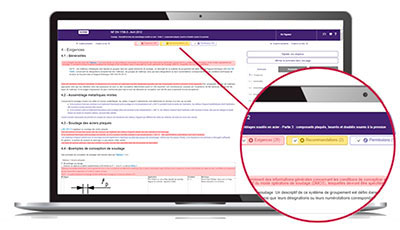
ZOOM SUR... le service Exigences

Pour respecter une norme, vous avez besoin de comprendre rapidement ses enjeux afin de déterminer son impact sur votre activité.

Le service Exigences vous aide à repérer rapidement au sein du texte normatif :

  • les clauses impératives à satisfaire,
  • les clauses non indispensables mais utiles à connaitre, telles que les permissions et les recommandations.

L'identification de ces types de clauses repose sur le document « Directives ISO/IEC, Partie 2 - Principes et règles de structure et de rédaction des documents ISO » ainsi que sur une liste de formes verbales constamment enrichie.

Avec Exigences, accédez rapidement à l'essentiel du texte normatif !


Besoin d’identifier, de veiller et de décrypter les normes ?