ISO/IEC 19770-1:2017
Information technology — IT asset management — Part 1: IT asset management systems — Requirements
ISO/IEC 19770-1:2017 specifies requirements for an IT asset management system within the context of the organization.ISO/IEC 19770-1:2017 can be applied to all types of IT assets and by all types and sizes of organizations.NOTE 1 This document is intended to be used for managing IT assets in particular, but it can also be applied to other asset types. It can be suitable, in whole or in part, for managing embedded software and firmware, however its use for these purposes has not been determined. It is not intended for managing information assets per se, i.e. it is not intended for managing information as an asset independent of hardware and software assets. Certain types of data and information are covered, such as data and information about IT assets in scope, and depending on how the scope is defined, it can cover digital information content assets. See the Introduction for an explanation about IT assets.NOTE 2 This document does not specify financial, accounting, or technical requirements for managing specific IT asset types.NOTE 3 For the purposes of this document, the term "IT asset management system" is used to refer to a management system for IT asset management.ISO/IEC 19770-1:2017 is a discipline-specific extension of ISO 55001:2014, with changes, and is not a sector-specific application of that International Standard. ISO 55001:2014 is intended to be used for managing physical assets in particular, but it can also be applied to other asset types. This document specifies requirements for the management of IT assets which are additional to those specified in ISO 55001:2014. Conformance to this document does not imply conformance to ISO 55001:2014.ISO/IEC 19770-1:2017 can be used by internal and external parties to assess the organization's ability to meet the organization's own IT asset management requirements.
ISO/IEC 19770-1:2017 specifies requirements for an IT asset management system within the context of the organization.
ISO/IEC 19770-1:2017 can be applied to all types of IT assets and by all types and sizes of organizations.
NOTE 1 This document is intended to be used for managing IT assets in particular, but it can also be applied to other asset types. It can be suitable, in whole or in part, for managing embedded software and firmware, however its use for these purposes has not been determined. It is not intended for managing information assets per se, i.e. it is not intended for managing information as an asset independent of hardware and software assets. Certain types of data and information are covered, such as data and information about IT assets in scope, and depending on how the scope is defined, it can cover digital information content assets. See the Introduction for an explanation about IT assets.
NOTE 2 This document does not specify financial, accounting, or technical requirements for managing specific IT asset types.
NOTE 3 For the purposes of this document, the term "IT asset management system" is used to refer to a management system for IT asset management.
ISO/IEC 19770-1:2017 is a discipline-specific extension of ISO 55001:2014, with changes, and is not a sector-specific application of that International Standard. ISO 55001:2014 is intended to be used for managing physical assets in particular, but it can also be applied to other asset types. This document specifies requirements for the management of IT assets which are additional to those specified in ISO 55001:2014. Conformance to this document does not imply conformance to ISO 55001:2014.
ISO/IEC 19770-1:2017 can be used by internal and external parties to assess the organization's ability to meet the organization's own IT asset management requirements.
L'ISO/CEI 19770:2012 établit une base de référence pour un ensemble intégré de processus de gestion des actifs logiciels (SAM, Software Asset Management), laquelle est divisée en paliers pour permettre sa mise en ?uvre, son évaluation et sa reconnaissance de manière progressive.
Pour respecter une norme, vous avez besoin de comprendre rapidement ses enjeux afin de déterminer son impact sur votre activité.
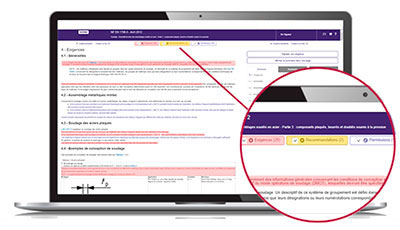
Le service Exigences vous aide à repérer rapidement au sein du texte normatif :
- les clauses impératives à satisfaire,
- les clauses non indispensables mais utiles à connaitre, telles que les permissions et les recommandations.
L'identification de ces types de clauses repose sur le document « Directives ISO/IEC, Partie 2 - Principes et règles de structure et de rédaction des documents ISO » ainsi que sur une liste de formes verbales constamment enrichie.
Avec Exigences, accédez rapidement à l'essentiel du texte normatif !

COBAZ est la solution simple et efficace pour répondre aux besoins normatifs liés à votre activité, en France comme à l’étranger.
Disponible sur abonnement, CObaz est LA solution modulaire à composer selon vos besoins d’aujourd’hui et de demain. Découvrez vite CObaz !
Demandez votre démo live gratuite, sans engagement
Je découvre COBAZ