SAE J 1252
SAE J 1252

SAE J 1252

juillet 2012
Norme En vigueur

SAE Wind Tunnel Test Procedure for Trucks and Buses

The scope of this SAE Recommended Practice is sufficiently broad that it encompasses the full range of full-scale medium and heavy duty vehicles represented as either full-scale or reduced-scale wind tunnel models. The document provides guidance for wind tunnel testing to support current vehicle characterization, vehicle development, vehicle concept development, and vehicle component development.Wind tunnel testing of heavy vehicles has evolved in the past thirty years with new facility types, new ground simulation techniques, and more robust methods for estimating aerodynamic force and moment coefficients. References have been added for support of the narrative and emphasize the common elements between automotive and heavy vehicle testing, and thus avoid duplication of material. The origin of the US average annual wind speed was not disclosed in the original document and is now supported by references and calculations performed by the revision task force. The derivation of the wind averaged drag coefficient and a sample calculation have been added for completeness. Uncertainty bounds are a required element for any contemporary wind tunnel test report and a suggested uncertainty analysis method has been added for the first time with an included sample calculation.

Informations générales

Collections

Normes américaines SAE

Date de publication

juillet 2012

Nombre de pages

26 p.

Référence

SAE J 1252

Indice de classement

J1252_201207

Parenté internationale

ASMEPTC19.1
Résumé
SAE Wind Tunnel Test Procedure for Trucks and Buses

The scope of this SAE Recommended Practice is sufficiently broad that it encompasses the full range of full-scale medium and heavy duty vehicles represented as either full-scale or reduced-scale wind tunnel models. The document provides guidance for wind tunnel testing to support current vehicle characterization, vehicle development, vehicle concept development, and vehicle component development. Wind tunnel testing of heavy vehicles has evolved in the past thirty years with new facility types, new ground simulation techniques, and more robust methods for estimating aerodynamic force and moment coefficients. References have been added for support of the narrative and emphasize the common elements between automotive and heavy vehicle testing, and thus avoid duplication of material. The origin of the US average annual wind speed was not disclosed in the original document and is now supported by references and calculations performed by the revision task force. The derivation of the wind averaged drag coefficient and a sample calculation have been added for completeness. Uncertainty bounds are a required element for any contemporary wind tunnel test report and a suggested uncertainty analysis method has been added for the first time with an included sample calculation.
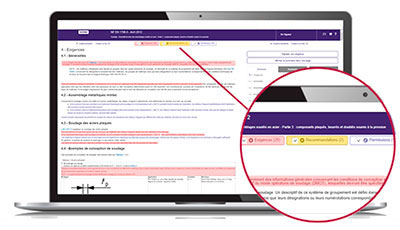
ZOOM SUR... le service Exigences

Pour respecter une norme, vous avez besoin de comprendre rapidement ses enjeux afin de déterminer son impact sur votre activité.

Le service Exigences vous aide à repérer rapidement au sein du texte normatif :

  • les clauses impératives à satisfaire,
  • les clauses non indispensables mais utiles à connaitre, telles que les permissions et les recommandations.

L'identification de ces types de clauses repose sur le document « Directives ISO/IEC, Partie 2 - Principes et règles de structure et de rédaction des documents ISO » ainsi que sur une liste de formes verbales constamment enrichie.

Avec Exigences, accédez rapidement à l'essentiel du texte normatif !

Besoin d’identifier, de veiller et de décrypter les normes ?