IEC 62746-10-1:2018
IEC 62746-10-1:2018

IEC 62746-10-1:2018

novembre 2018
Norme internationale En vigueur

Systems interface between customer energy management system and the power management system - Part 10-1: Open automated demand response

IEC 62746-10-1:2018 specifies a minimal data model and services for demand response (DR), pricing, and distributed energy resource (DER) communications. This document can be leveraged to manage customer energy resources, including load, generation, and storage, via signals provided by grid and/or market operators. These resources can be identified and managed as individual resources with specific capabilities, or as virtual resources with an aggregated set of capabilities. It specifies how to implement a two-way signaling system to facilitate information exchange between electricity service providers, aggregators, and end users. The DR signalling system is described in terms of servers (virtual top nodes or VTNs), which publish information to automated clients (virtual end nodes, or VENs), which in turn subscribe to the information. The services make no assumption of specific DR electric load control strategies that can be used within a DR resource or of any market-specific contractual or business agreements between electricity service providers and their customers.


Informations générales

Collections

Normes internationales IEC

Date de publication

novembre 2018

Nombre de pages

207 p.

Référence

IEC 62746-10-1:2018

Codes ICS

33.200   Télécommande. Télémesure
Résumé
Systems interface between customer energy management system and the power management system - Part 10-1: Open automated demand response

IEC 62746-10-1:2018 specifies a minimal data model and services for demand response (DR), pricing, and distributed energy resource (DER) communications. This document can be leveraged to manage customer energy resources, including load, generation, and storage, via signals provided by grid and/or market operators. These resources can be identified and managed as individual resources with specific capabilities, or as virtual resources with an aggregated set of capabilities. It specifies how to implement a two-way signaling system to facilitate information exchange between electricity service providers, aggregators, and end users. The DR signalling system is described in terms of servers (virtual top nodes or VTNs), which publish information to automated clients (virtual end nodes, or VENs), which in turn subscribe to the information. The services make no assumption of specific DR electric load control strategies that can be used within a DR resource or of any market-specific contractual or business agreements between electricity service providers and their customers.
Normes remplacées (1)
IEC PAS 62746-10-1:2014
février 2014
Norme Annulée
Systems interface between customer energy management system and the power management system - Part 10-1: Open Automated Demand Response (OpenADR 2.0b Profile Specification)

IEC PAS 62746-10-1:2014-02(en), originally designated as OpenADR 2.0b profile specification, is a flexible data model to facilitate common information exchange between electricity service providers, aggregators, and end users. The concept of an open specification is intended to allow anyone to implement the two-way signalling systems, providing the servers, which publish information to the automated clients, which subscribe the information. This OpenADR 2.0 profile specification covers the signalling data models and includes information related to specific DR (Demand Response) electric reduction or shifting strategies, which are taken at the facility. The PDF version of the standard is accompanied by Profile B Schema files.

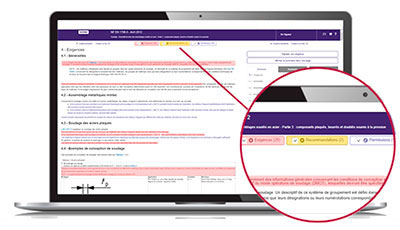
ZOOM SUR... le service Exigences

Pour respecter une norme, vous avez besoin de comprendre rapidement ses enjeux afin de déterminer son impact sur votre activité.

Le service Exigences vous aide à repérer rapidement au sein du texte normatif :

  • les clauses impératives à satisfaire,
  • les clauses non indispensables mais utiles à connaitre, telles que les permissions et les recommandations.

L'identification de ces types de clauses repose sur le document « Directives ISO/IEC, Partie 2 - Principes et règles de structure et de rédaction des documents ISO » ainsi que sur une liste de formes verbales constamment enrichie.

Avec Exigences, accédez rapidement à l'essentiel du texte normatif !


Besoin d’identifier, de veiller et de décrypter les normes ?