At the publisher's request, the document is available for consultation only in PDF format with single-user use and printing is not permitted. If you are not the intended user of this document, do not download it to your computer, otherwise the intended user will not be able to open it.
ASTM A229/A229M-17
Standard Specification for Steel Wire, Quenched and Tempered for Mechanical Springs
This specification covers two classes of oil-tempered steel spring wire intended especially for the manufacture of mechanical springs and wire forms. The steel may be made by any commercially accepted steel-making process and shall either be ingot cast or strand cast. The finished wire shall be free of detrimental pipe and undue segregation. The wire shall be oil quenched and tempered to produce the desired mechanical properties such as tensile strength. Cast, heat, and product analysis shall conform to the chemical composition requirements prescribed for carbon, manganese, phosphorus, sulfur, and silicon. Tension, wrap, and surface tests shall be performed. The surface of the wire as-received shall be free of rust, excessive scale die marks, pits, and scratches detrimental to the end application. Other metallurgical requirements such as microstructure and decarburization are detailed.
At the publisher's request, the document is available for consultation only in PDF format with single-user use and printing is not permitted. If you are not the intended user of this document, do not download it to your computer, otherwise the intended user will not be able to open it.
1.1 This specification covers two classes of commercial quality round and shaped quenched and tempered steel spring wire intended especially for the manufacture of mechanical springs and wire forms. The quality level is lower than specialty spring quality (Specification A1000/A1000M) or valve spring quality (Specification A230/A230M).
1.2 The values stated in either SI units or inch-pound units are to be regarded separately as standard. The values stated in each system are not necessarily exact equivalents; therefore, each system shall be used independently of the other. Combining values from the two systems can result in non-conformance with the standard.
1.3 This international standard was developed in accordance with internationally recognized principles on standardization established in the Decision on Principles for the Development of International Standards, Guides and Recommendations issued by the World Trade Organization Technical Barriers to Trade (TBT) Committee.
Collections
Publication date
Number of pages
Reference
Classification index
This specification covers two classes of oil-tempered steel spring wire intended especially for the manufacture of mechanical springs and wire forms. The steel may be made by any commercially accepted steel-making process and shall either be ingot cast or strand cast. The finished wire shall be free of detrimental pipe and undue segregation. The wire shall be oil quenched and tempered to produce the desired mechanical properties such as tensile strength. Cast, heat, and product analysis shall conform to the chemical composition requirements prescribed for carbon, manganese, phosphorus, sulfur, and silicon. Tension, wrap, and surface tests shall be performed. The surface of the wire as-received shall be free of rust, excessive scale die marks, pits, and scratches detrimental to the end application. Other metallurgical requirements such as microstructure and decarburization are detailed.
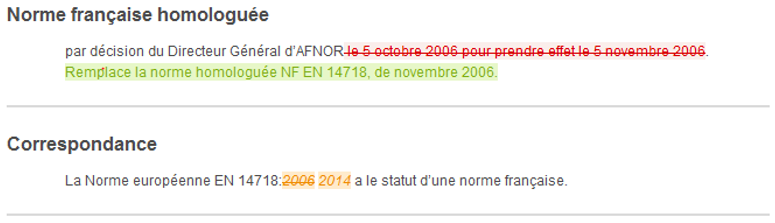
At a glance, you will be able to identify the additions, deletions or modifications to a text, table, figure and formula.

The Redlines + service is offered to you on the collection of French standards in force, in French language and in HTML and PDF format.
For an overview of the service, click on View a standard in redline format
COBAZ is the simple and effective solution to meet the normative needs related to your activity, in France and abroad.
Available by subscription, CObaz is THE modular solution to compose according to your needs today and tomorrow. Quickly discover CObaz!
Request your free, no-obligation live demo
I discover COBAZ