At the publisher's request, the document is available for consultation only in PDF format with single-user use and printing is not permitted. If you are not the intended user of this document, do not download it to your computer, otherwise the intended user will not be able to open it.
ASTM A350/A350M-18
Standard Specification for Carbon and Low-Alloy Steel Forgings, Requiring Notch Toughness Testing for Piping Components
This specification covers several grades of carbon and low alloy steel forged or ring-rolled flanges, forged fittings and valves for low-temperature service. The steel specimens shall be melt processed using open-hearth, basic oxygen, electric furnace or vacuum-induction melting. A sufficient discard shall be made to secure freedom from injurious piping and undue segregation. The materials shall be forged and shall undergo heat treatment such as normalizing, tempering, quenching and precipitation heat treatment. Heat analysis and product analysis shall be performed wherein the steel materials shall conform to the required chemical compositions of carbon, manganese, phosphorus, sulfur, silicon, nickel, chromium, molybdenum, copper, columbium, vanadium, and nitrogen. The materials shall also undergo tension tests and shall conform to the required values of tensile strength, yield strength and elongation. Impact tests shall also be performed and the steel materials shall conform to the required values of minimum impact energy, temperature, and minimum equivalent absorbed energy. Hardness and hydrostatic tests shall also be performed.
At the publisher's request, the document is available for consultation only in PDF format with single-user use and printing is not permitted. If you are not the intended user of this document, do not download it to your computer, otherwise the intended user will not be able to open it.
1.1 This specification2 covers several grades of carbon and low-alloy steel forged or ring-rolled flanges, forged fittings and valves intended primarily for low-temperature service and requiring notch toughness testing. They are made to specified dimensions, or to dimensional standards, such as the ASME and API Specifications referenced in Section 2. Although this specification covers some piping components machined from rolled bar and seamless tubular materials (see 5.3.3), it does not cover raw material produced in these product forms.
1.2 No limitation on size is intended beyond the ability of the manufacturer to obtain the specified requirements. However, Class 3 of Grade LF787 is only available in the quenched-and-precipitation heat treated condition.
1.3 Supplementary requirements are provided for use when additional testing or inspection is desired. These shall apply only when specified by the purchaser in the order.
1.4 This specification is expressed in both inch-pound units and in SI units. However, unless the order specifies the applicable “M” specification designation (SI units), the material shall be furnished to inch-pound units.
1.5 The values stated in either SI units or inch-pound units are to be regarded separately as standard. Within the text, the SI units are shown in brackets. The values stated in each system may not be exact equivalents; therefore, each system shall be used independently of the other. Combining values from the two systems may result in non-conformance with the standard.
1.6 This international standard was developed in accordance with internationally recognized principles on standardization established in the Decision on Principles for the Development of International Standards, Guides and Recommendations issued by the World Trade Organization Technical Barriers to Trade (TBT) Committee.
Collections
Publication date
Number of pages
Reference
Classification index
This specification covers several grades of carbon and low alloy steel forged or ring-rolled flanges, forged fittings and valves for low-temperature service. The steel specimens shall be melt processed using open-hearth, basic oxygen, electric furnace or vacuum-induction melting. A sufficient discard shall be made to secure freedom from injurious piping and undue segregation. The materials shall be forged and shall undergo heat treatment such as normalizing, tempering, quenching and precipitation heat treatment. Heat analysis and product analysis shall be performed wherein the steel materials shall conform to the required chemical compositions of carbon, manganese, phosphorus, sulfur, silicon, nickel, chromium, molybdenum, copper, columbium, vanadium, and nitrogen. The materials shall also undergo tension tests and shall conform to the required values of tensile strength, yield strength and elongation. Impact tests shall also be performed and the steel materials shall conform to the required values of minimum impact energy, temperature, and minimum equivalent absorbed energy. Hardness and hydrostatic tests shall also be performed.
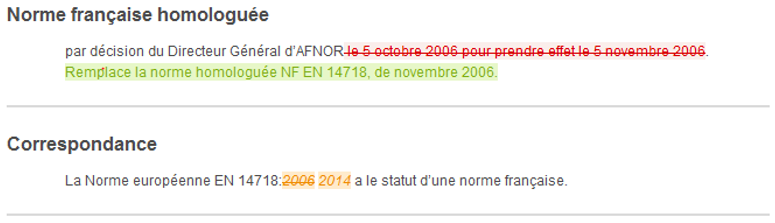
At a glance, you will be able to identify the additions, deletions or modifications to a text, table, figure and formula.

The Redlines + service is offered to you on the collection of French standards in force, in French language and in HTML and PDF format.
For an overview of the service, click on View a standard in redline format
COBAZ is the simple and effective solution to meet the normative needs related to your activity, in France and abroad.
Available by subscription, CObaz is THE modular solution to compose according to your needs today and tomorrow. Quickly discover CObaz!
Request your free, no-obligation live demo
I discover COBAZ