At the publisher's request, the document is available for consultation only in PDF format with single-user use and printing is not permitted. If you are not the intended user of this document, do not download it to your computer, otherwise the intended user will not be able to open it.
ASTM A388/A388M-09
Standard Practice for Ultrasonic Examination of Steel Forgings
This practice covers the examination procedures for the contact, pulse-echo ultrasonic examination of heavy steel forgings by the straight and angle-beam techniques. An ultrasonic, pulsed, reflection type of instrument shall be used and shall provide linear presentation for at least 75% of the screen height. The 5% linearity referred to is descriptive of the screen presentation of amplitude. The electronic apparatus shall contain an attenuator, search units, transducers, couplants, reference blocks, and DGS scales. The forging shall be machined to provide cylindrical surfaces for radial examination in the case of round forgings. The ends of the forgings shall be machined perpendicular to the axis of the forging for the axial examination. Faces of disk and rectangular forgings shall be machined flat and parallel to one another. The procedures to be performed are as follows: ultrasonic examination of the forgings; straight-beam examination with establishment of the instrument sensitivity and calibration either by the reflection, reference-block technique, or DGS method; and angle-beam examination used for rings and hollow forgings.
At the publisher's request, the document is available for consultation only in PDF format with single-user use and printing is not permitted. If you are not the intended user of this document, do not download it to your computer, otherwise the intended user will not be able to open it.
1.1 This practice covers the examination procedures for the contact, pulse-echo ultrasonic examination of steel forgings by the straight and angle-beam techniques. The straight beam techniques include utilization of the DGS (Distance Gain-Size) method. See Appendix X3.
1.2 This practice is to be used whenever the inquiry, contract, order, or specification states that forgings are to be subject to ultrasonic examination in accordance with Practice A 388/A 388M.
1.3 The values stated in either SI units or inch-pound units are to be regarded separately as standard. The values stated in each system may not be exact equivalents; therefore, each system shall be used independently of the other. Combining values from the two systems may result in non-conformance with the standard.
1.4 This specification and the applicable material specifications are expressed in both inch-pound units and SI units. However, unless the order specifies the applicable “M” specification designation [SI units], the material shall be furnished to inch-pound units.
1.5 This standard does not purport to address all of the safety concerns, if any, associated with its use. It is the responsibility of the user of this standard to establish appropriate safety and health practices and determine the applicability of regulatory limitations prior to use.
Collections
Publication date
Number of pages
Reference
Classification index
This practice covers the examination procedures for the contact, pulse-echo ultrasonic examination of heavy steel forgings by the straight and angle-beam techniques. An ultrasonic, pulsed, reflection type of instrument shall be used and shall provide linear presentation for at least 75% of the screen height. The 5% linearity referred to is descriptive of the screen presentation of amplitude. The electronic apparatus shall contain an attenuator, search units, transducers, couplants, reference blocks, and DGS scales. The forging shall be machined to provide cylindrical surfaces for radial examination in the case of round forgings. The ends of the forgings shall be machined perpendicular to the axis of the forging for the axial examination. Faces of disk and rectangular forgings shall be machined flat and parallel to one another. The procedures to be performed are as follows: ultrasonic examination of the forgings; straight-beam examination with establishment of the instrument sensitivity and calibration either by the reflection, reference-block technique, or DGS method; and angle-beam examination used for rings and hollow forgings.
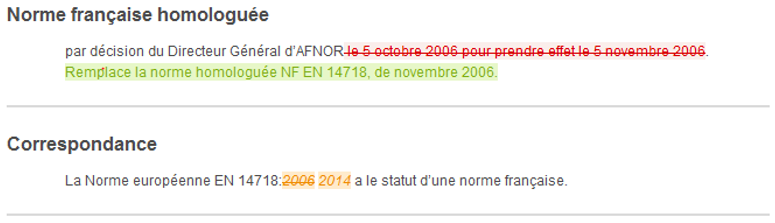
At a glance, you will be able to identify the additions, deletions or modifications to a text, table, figure and formula.

The Redlines + service is offered to you on the collection of French standards in force, in French language and in HTML and PDF format.
For an overview of the service, click on View a standard in redline format
COBAZ is the simple and effective solution to meet the normative needs related to your activity, in France and abroad.
Available by subscription, CObaz is THE modular solution to compose according to your needs today and tomorrow. Quickly discover CObaz!
Request your free, no-obligation live demo
I discover COBAZ