

ASTM A391/A391M-21
ASTM A391/A391M-21

ASTM A391/A391M-21

January 2021
Standard Current

Standard Specification for Grade 80 Alloy Steel Chain

This specification deals with Grade 80 heat-treated alloy steel chain for applications such as slings, lifting assemblies, and load binding. The alloy steel chain shall be made to a fully-killed fine austenitic grain process. Alloy steel chain may be made by the electric welding or gas welding process. The material shall be heat treated which includes quenching and tempering. Material's composition shall conform to the chemical requirements for carbon, phosphorous, sulfur, nickel, chromium, and molybdenum. The material shall conform to the mechanical property requirements for breaking force and elongation and to the dimensional requirements for the appropriate size chain. All chain shall be tested to at least the proof load.

Important information
To view this document, the FileOpen plug-in must be installed.
At the publisher's request, the document is available for consultation only in PDF format with single-user use and printing is not permitted. If you are not the intended user of this document, do not download it to your computer, otherwise the intended user will not be able to open it.
If you have any problems, please click here to contact customer support
If you haven't already done so, download the plug-in HERE
Consult HERE our prerequisites.
Additional informations

1.1 This specification covers Grade 80 heat-treated alloy steel chain for such applications as slings, lifting assemblies, and load binding. For overhead lifting applications, only alloy chain should be used.

1.2 The chain grade is based on the nominal stress in the link at the design breaking force strength. It is calculated by taking the minimum breaking force load and dividing by two times the nominal cross-sectional area of the link.

1.3 The values stated in either SI units or in other units are to be regarded separately as standard. The values stated in each system are not necessarily exact equivalents; therefore, to ensure conformance with the standard, each system shall be used independently of the other, and values from the two systems shall not be combined.

1.3.1 Metric Units—Grade = 1/10 of the minimum breaking force in kilonewtons divided by two times the nominal cross-sectional area in square millimeters. = (MBF)/(0.005)(π)(d)(d)

1.3.2 English Units—Grade = 0.000689 of the minimum breaking force in pounds divided by two times the nominal cross-sectional area in square inches. = (0.000689)(MBF)/(0.5)(π)(d)(d)

1.3.3 MBF = minimum breaking force (lb or kN); d = chain diameter (in. or mm).

Note 1: The above formulas are for round diameter links only. If different cross sections are used, the actual cross section of the link would need to be calculated and used.

1.4 This international standard was developed in accordance with internationally recognized principles on standardization established in the Decision on Principles for the Development of International Standards, Guides and Recommendations issued by the World Trade Organization Technical Barriers to Trade (TBT) Committee.


Main informations

Collections

ASTM american standards

Publication date

January 2021

Number of pages

4 p.

Reference

ASTM A391/A391M-21

Classification index

A0391_A0391M-21
Sumary
Standard Specification for Grade 80 Alloy Steel Chain

This specification deals with Grade 80 heat-treated alloy steel chain for applications such as slings, lifting assemblies, and load binding. The alloy steel chain shall be made to a fully-killed fine austenitic grain process. Alloy steel chain may be made by the electric welding or gas welding process. The material shall be heat treated which includes quenching and tempering. Material's composition shall conform to the chemical requirements for carbon, phosphorous, sulfur, nickel, chromium, and molybdenum. The material shall conform to the mechanical property requirements for breaking force and elongation and to the dimensional requirements for the appropriate size chain. All chain shall be tested to at least the proof load.

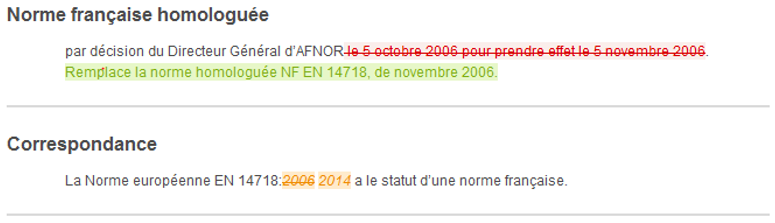
What is the Redline format?
The Redline + service - standards comparator allows you to easily and simply identify major changes between the current standard and its last canceled version.

At a glance, you will be able to identify the additions, deletions or modifications to a text, table, figure and formula.
At a glance, you will be able to identify the additions, deletions or modifications to a text, table, figure and formula

The Redlines + service is offered to you on the collection of French standards in force, in French language and in HTML and PDF format.

For an overview of the service, click on View a standard in redline format
Need to identify, monitor and decipher standards?

COBAZ is the simple and effective solution to meet the normative needs related to your activity, in France and abroad.

Available by subscription, CObaz is THE modular solution to compose according to your needs today and tomorrow. Quickly discover CObaz!

Request your free, no-obligation live demo

I discover COBAZ