
ASTM B23-00(2014)

ASTM B23-00(2014)

October 2014
Standard Cancelled

Standard Specification for White Metal Bearing Alloys<brk/> &#40;Known Commercially as &ldquo;Babbitt Metal&rdquo;&#41;

This specification deals with eight typical white metal bearing alloys, in bar or ingot form, known commercially as "Babbitt metal." Covered in this specification are tin-based alloys, namely, UNS-L13910 (alloy no. 1), UNS-L13890 (alloy no. 2), UNS-L13840 (alloy no. 3), and UNS-L13870 (alloy no. 11); and lead-based alloys, namely, UNS-L53585 (alloy no. 7), UNS-L53565 (alloy no. 8), UNS-L53346 (alloy no. 13), and UNS-L53620 (alloy no. 15). Materials shall be manufactured in accordance with such practice as to obtain the chemical composition, weight, and dimensions as prescribed herein.

Important information
To view this document, the FileOpen plug-in must be installed.
At the publisher's request, the document is available for consultation only in PDF format with single-user use and printing is not permitted. If you are not the intended user of this document, do not download it to your computer, otherwise the intended user will not be able to open it.
If you have any problems, please click here to contact customer support
If you haven't already done so, download the plug-in HERE
Consult HERE our prerequisites.
Additional informations

1.1 This specification covers eight typical white metal bearing alloys, in bar or ingot form, known commercially as “babbitt metal.” The alloys are specified, covering the range commercially used, and are designated by the alloy numbers shown in Table 1.

(A) Alloy Number 9 was discontinued in 1946 and numbers 4, 5, 6, 10, 11, 12, 16, and 19 were discontinued in 1959. A new number 11, similar to SAE Grade 11, was added in 1966.
(B) To be determined by difference.

1.2 The values stated in inch-pound units are to be regarded as standard. The values given in parentheses are mathematical conversions to SI units that are provided for information only and are not considered standard.

1.3 This standard does not purport to address all of the safety concerns, if any, associated with its use. It is the responsibility of the user of this standard to become familiar with all hazards including those identified in the appropriate Material Safety Data Sheet (MSDS) for this product/material as provided by the manufacturer, to establish appropriate safety and health practices, and determine the applicability of regulatory limitations prior to use.


Main informations

Collections

ASTM american standards

Publication date

October 2014

Number of pages

4 p.

Reference

ASTM B23-00(2014)

Classification index

B0023-00R14
Sumary
Standard Specification for White Metal Bearing Alloys (Known Commercially as “Babbitt Metal”)

This specification deals with eight typical white metal bearing alloys, in bar or ingot form, known commercially as "Babbitt metal." Covered in this specification are tin-based alloys, namely, UNS-L13910 (alloy no. 1), UNS-L13890 (alloy no. 2), UNS-L13840 (alloy no. 3), and UNS-L13870 (alloy no. 11); and lead-based alloys, namely, UNS-L53585 (alloy no. 7), UNS-L53565 (alloy no. 8), UNS-L53346 (alloy no. 13), and UNS-L53620 (alloy no. 15). Materials shall be manufactured in accordance with such practice as to obtain the chemical composition, weight, and dimensions as prescribed herein.

Standard replaced by (1)
ASTM B23-20
October 2020
Standard Cancelled
Standard Specification for White Metal Bearing Alloys<brk/> (Known Commercially as &#x201c;Babbitt Metal&#x201d;)

This specification deals with eight typical white metal bearing alloys, in bar or ingot form, known commercially as "Babbitt metal." Covered in this specification are tin-based alloys, namely, UNS-L13910 (alloy no. 1), UNS-L13890 (alloy no. 2), UNS-L13840 (alloy no. 3), and UNS-L13870 (alloy no. 11); and lead-based alloys, namely, UNS-L53585 (alloy no. 7), UNS-L53565 (alloy no. 8), UNS-L53346 (alloy no. 13), and UNS-L53620 (alloy no. 15). Materials shall be manufactured in accordance with such practice as to obtain the chemical composition, weight, and dimensions as prescribed herein.

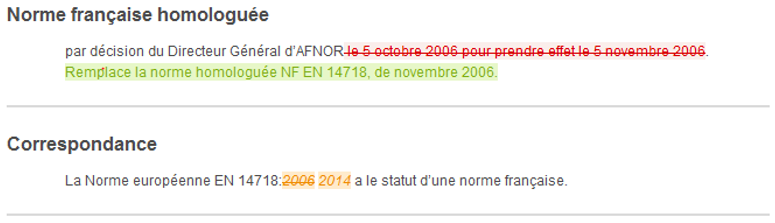
What is the Redline format?
The Redline + service - standards comparator allows you to easily and simply identify major changes between the current standard and its last canceled version.

At a glance, you will be able to identify the additions, deletions or modifications to a text, table, figure and formula.
At a glance, you will be able to identify the additions, deletions or modifications to a text, table, figure and formula

The Redlines + service is offered to you on the collection of French standards in force, in French language and in HTML and PDF format.

For an overview of the service, click on View a standard in redline format
Need to identify, monitor and decipher standards?

COBAZ is the simple and effective solution to meet the normative needs related to your activity, in France and abroad.

Available by subscription, CObaz is THE modular solution to compose according to your needs today and tomorrow. Quickly discover CObaz!

Request your free, no-obligation live demo

I discover COBAZ