At the publisher's request, the document is available for consultation only in PDF format with single-user use and printing is not permitted. If you are not the intended user of this document, do not download it to your computer, otherwise the intended user will not be able to open it.
ASTM C494/C494M-10a
Standard Specification for Chemical Admixtures for Concrete
This specification covers the materials and the test methods for use in chemical admixtures to be added to hydraulic-cement concrete mixtures in the field. The seven types of admixtures are indicated as follows: Type A—water reducing; Type B—retarding; Type C—accelerating; Type D—water reducing and retarding; Type E—water reducing and accelerating; Type F—water reducing, high range; and Type G—water reducing, high range, and retarding. The materials used in the concrete mixtures shall include Type I or Type II cement, pozzolan, fine and coarse aggregates, and air-entraining admixture. Samples of freshly mixed concrete from at least three separate batches for each condition of concrete shall be tested in accordance with the slump, air content, time of setting, and water content tests. Physical properties retesting shall consist of uniformity and equivalence tests using infrared analysis which is intended to compare qualitatively the composition of different samples, residue by oven drying which shall be either a forced circulation type or one with provision for free access of air, and specific gravity determination using hydrometers. Test specimens of the hardened concrete shall be prepared in accordance to compressive strength, flexural strength, resistance to freezing and thawing, and length change.
At the publisher's request, the document is available for consultation only in PDF format with single-user use and printing is not permitted. If you are not the intended user of this document, do not download it to your computer, otherwise the intended user will not be able to open it.
1.1 This specification covers materials for use as chemical admixtures to be added to hydraulic-cement concrete mixtures in the field for the purpose or purposes indicated for the eight types as follows:
1.1.1 Type A—Water-reducing admixtures,
1.1.2 Type B—Retarding admixtures,
1.1.3 Type C—Accelerating admixtures,
1.1.4 Type D—Water-reducing and retarding admixtures,
1.1.5 Type E—Water-reducing and accelerating admixtures,
1.1.6 Type F—Water-reducing, high range admixtures,
1.1.7 Type G—Water-reducing, high range, and retarding admixtures, and
1.1.8 Type S—Specific performance admixtures.
1.2 This specification stipulates tests of an admixture with suitable concreting materials as described in 11.1-11.3 or with cement, pozzolan, aggregates, and an air-entraining admixture proposed for specific work (11.4). Unless specified otherwise by the purchaser, the tests shall be made using concreting materials as described in 11.1-11.3.
Note 1—It is recommended that, whenever practicable, tests be made using the cement, pozzolan, aggregates, air-entraining admixture, and the mixture proportions, batching sequence, and other physical conditions proposed for the specific work (11.4) because the specific effects produced by chemical admixtures may vary with the properties and proportions of the other ingredients of the concrete. For instance, Types F and G admixtures may exhibit much higher water reduction in concrete mixtures having higher cement factors than that listed in 12.1.1.
Collections
Publication date
Number of pages
Reference
Classification index
This specification covers the materials and the test methods for use in chemical admixtures to be added to hydraulic-cement concrete mixtures in the field. The seven types of admixtures are indicated as follows: Type A—water reducing; Type B—retarding; Type C—accelerating; Type D—water reducing and retarding; Type E—water reducing and accelerating; Type F—water reducing, high range; and Type G—water reducing, high range, and retarding. The materials used in the concrete mixtures shall include Type I or Type II cement, pozzolan, fine and coarse aggregates, and air-entraining admixture. Samples of freshly mixed concrete from at least three separate batches for each condition of concrete shall be tested in accordance with the slump, air content, time of setting, and water content tests. Physical properties retesting shall consist of uniformity and equivalence tests using infrared analysis which is intended to compare qualitatively the composition of different samples, residue by oven drying which shall be either a forced circulation type or one with provision for free access of air, and specific gravity determination using hydrometers. Test specimens of the hardened concrete shall be prepared in accordance to compressive strength, flexural strength, resistance to freezing and thawing, and length change.
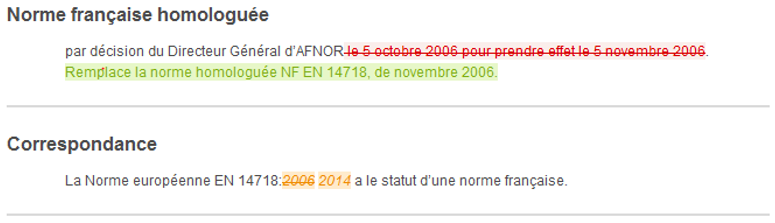
At a glance, you will be able to identify the additions, deletions or modifications to a text, table, figure and formula.

The Redlines + service is offered to you on the collection of French standards in force, in French language and in HTML and PDF format.
For an overview of the service, click on View a standard in redline format
COBAZ is the simple and effective solution to meet the normative needs related to your activity, in France and abroad.
Available by subscription, CObaz is THE modular solution to compose according to your needs today and tomorrow. Quickly discover CObaz!
Request your free, no-obligation live demo
I discover COBAZ