At the publisher's request, the document is available for consultation only in PDF format with single-user use and printing is not permitted. If you are not the intended user of this document, do not download it to your computer, otherwise the intended user will not be able to open it.
ASTM D3776/D3776M-20
Standard Test Methods for Mass Per Unit Area (Weight) of Fabric
These test methods cover the measurement of fabric mass per unit area (weight) and is applicable to most fabrics. There are four approved options in the measurement of fabric mass per unit area: Option A, Option B, Option C, and Option D. Option A may be used for acceptance testing of commercial shipments since it has been used extensively in the trade. The second option is Option B which is applicable to a full-width sample cut from a full piece, roll, bolt, or cut. Unless otherwise specified, these results will include selvages and will be on the basis of conditioned fabric. Option C on the other hand is applicable when a small swatch of fabric is sent to the laboratory to be used as the test specimen. The results are considered to be applicable to the sample only and not necessarily to the lot from which the sample was taken. Measurements by this method do not include selvages and should be reported as such, unless a selvage allowance is specified. The last option is Option D which is intended for use with narrow fabrics as so designated by the trade.
At the publisher's request, the document is available for consultation only in PDF format with single-user use and printing is not permitted. If you are not the intended user of this document, do not download it to your computer, otherwise the intended user will not be able to open it.
1.1 These test methods cover the measurement of fabric mass per unit area (traditionally referred to as “fabric weight”) and are applicable to most fabrics.
1.2 There are four approved options:
1.2.1 Option A—Full Piece, Roll, Bolt or Cut (Section 7).
1.2.2 Option B—Full Width Sample (Section 8).
1.2.3 Option C—Small Swatch of Fabric (Section 9).
1.2.4 Option D—Narrow Fabrics (Section 10).
1.3 The values stated in either SI units or inch-pound units are to be regarded separately as standard. The values stated in each system are not necessarily exact equivalents; therefore, to ensure conformance with the standard, each system shall be used independently of the other, and values from the two systems shall not be combined.
1.4 This standard does not purport to address all of the safety concerns, if any, associated with its use. It is the responsibility of the user of this standard to establish appropriate safety, health, and environmental practices and determine the applicability of regulatory limitations prior to use.
1.5 This international standard was developed in accordance with internationally recognized principles on standardization established in the Decision on Principles for the Development of International Standards, Guides and Recommendations issued by the World Trade Organization Technical Barriers to Trade (TBT) Committee.
Collections
Publication date
Number of pages
Reference
Classification index
These test methods cover the measurement of fabric mass per unit area (weight) and is applicable to most fabrics. There are four approved options in the measurement of fabric mass per unit area: Option A, Option B, Option C, and Option D. Option A may be used for acceptance testing of commercial shipments since it has been used extensively in the trade. The second option is Option B which is applicable to a full-width sample cut from a full piece, roll, bolt, or cut. Unless otherwise specified, these results will include selvages and will be on the basis of conditioned fabric. Option C on the other hand is applicable when a small swatch of fabric is sent to the laboratory to be used as the test specimen. The results are considered to be applicable to the sample only and not necessarily to the lot from which the sample was taken. Measurements by this method do not include selvages and should be reported as such, unless a selvage allowance is specified. The last option is Option D which is intended for use with narrow fabrics as so designated by the trade.
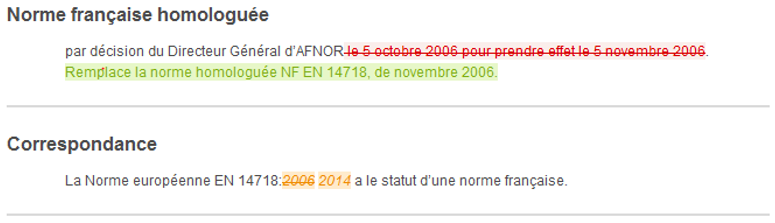
At a glance, you will be able to identify the additions, deletions or modifications to a text, table, figure and formula.

The Redlines + service is offered to you on the collection of French standards in force, in French language and in HTML and PDF format.
For an overview of the service, click on View a standard in redline format
COBAZ is the simple and effective solution to meet the normative needs related to your activity, in France and abroad.
Available by subscription, CObaz is THE modular solution to compose according to your needs today and tomorrow. Quickly discover CObaz!
Request your free, no-obligation live demo
I discover COBAZ