At the publisher's request, the document is available for consultation only in PDF format with single-user use and printing is not permitted. If you are not the intended user of this document, do not download it to your computer, otherwise the intended user will not be able to open it.
ASTM D6926-20
Standard Practice for Preparation of Asphalt Mixture Specimens Using Marshall Apparatus
At the publisher's request, the document is available for consultation only in PDF format with single-user use and printing is not permitted. If you are not the intended user of this document, do not download it to your computer, otherwise the intended user will not be able to open it.
1.1 This practice covers preparation and compaction of 4 in. (101.6 mm) diameter by nominal 2.5 in. (63.5 mm) high cylindrical asphalt paving mixture specimens. This practice is intended for use with laboratory and plant-produced asphalt mixtures with aggregate up to 1 in. (25.4 mm) maximum size and for recompaction of asphalt paving mixture samples.
Note 1: Historically, 35, 50, and 75 blows per face has been practiced for this test.
Note 2: Manufacturers do not recommend applying an excessive number of blows per face of a sample. This practice has been known to cause fatigue and damage to machine components.
1.2 There are three types of Marshall compaction apparatus in use. The following types of hammer arrangements are included in this practice:
1.2.1 Manually held hammer handle (Type 1) is attached to a flat compaction foot through a spring-loaded swivel and is hand operated (see 5.3.1) (original standard developed by the United States Army Corps of Engineers).
1.2.2 Hammer handle restrained laterally (fixed) but not vertically (Type 2), attached to a flat compaction foot through a spring-loaded swivel and is either mechanically or hand operated (see 5.3.2). There may or may not be a constant surcharge on top of the hammer handle. Mechanical hammers (Type 2) are available that operate at a range of 55 to 68 blows per minute.
1.2.3 Hammer handle restrained laterally (fixed) with or without constant surcharge on top of hammer, is attached to a slanted compaction foot on a rotating mold base (Type 3), and is mechanically operated (see 5.3.3). This method must be used as a referee method.
1.3 Although the mass and height of mass drop for each apparatus are the same, density achieved in compacted specimens with the same number of blows will be different. It is up to the owner or specifier to establish the specific required number of blows to be used for compaction of the specimen in relation to the field.
1.4 Units—The values stated in inch-pound units are to be regarded as standard. The values given in parentheses are mathematical conversions to SI units that are provided for information only and are not considered standard.
1.5 The text of this standard references notes and footnotes which provide explanatory material. These notes and footnotes (excluding those in tables and figures) shall not be considered as requirements of the standard.
1.6 This international standard was developed in accordance with internationally recognized principles on standardization established in the Decision on Principles for the Development of International Standards, Guides and Recommendations issued by the World Trade Organization Technical Barriers to Trade (TBT) Committee.
Collections
Publication date
Number of pages
Reference
Classification index
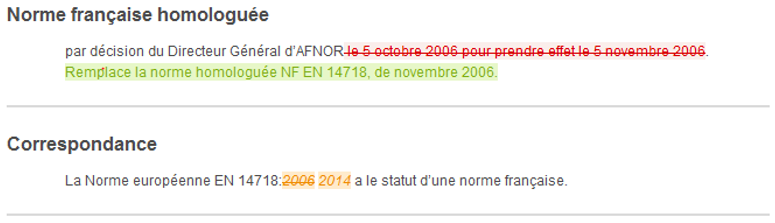
At a glance, you will be able to identify the additions, deletions or modifications to a text, table, figure and formula.

The Redlines + service is offered to you on the collection of French standards in force, in French language and in HTML and PDF format.
For an overview of the service, click on View a standard in redline format
COBAZ is the simple and effective solution to meet the normative needs related to your activity, in France and abroad.
Available by subscription, CObaz is THE modular solution to compose according to your needs today and tomorrow. Quickly discover CObaz!
Request your free, no-obligation live demo
I discover COBAZ