ASTM E83-25

ASTM E83-25

June 2025
Standard Current

Standard Practice for Calibration, Verification, and Classification of Extensometer Systems

This practice covers procedures for the verification and classification of extensometer systems, but it is not intended to be a complete purchase specification. The practice is applicable only to instruments that indicate or record values that are proportional to changes in length corresponding to either tensile or compressive strain. Extensometer systems are classified on the basis of the magnitude of their errors. The apparatus for verifying extensometer systems shall provide a means for applying controlled displacements to a simulated specimen and for measuring these displacements accurately. Extensometer systems shall be classified in accordance with the requirements as to maximum error of strain indicated: Class A; Class B-1; Class B-2; Class C; Class D; and Class E. Extensometer systems shall be categorized in three types according to gage length: Type 1; Type 2; and Type 3. A verification procedure for extensometer systems shall be done in accordance with the specified requirements.

Important information
To view this document, the FileOpen plug-in must be installed.
At the publisher's request, the document is available for consultation only in PDF format with single-user use and printing is not permitted. If you are not the intended user of this document, do not download it to your computer, otherwise the intended user will not be able to open it.
If you have any problems, please click here to contact customer support
If you haven't already done so, download the plug-in HERE
Consult HERE our prerequisites.
Additional informations

1.1 This practice covers procedures for the calibration, verification and classification of extensometer systems, but it is not intended to be a complete purchase specification. The practice is applicable only to instruments that indicate or record values that are proportional to changes in length corresponding to either tensile or compressive strain. Extensometer systems are classified on the basis of the magnitude of their strain measurement errors.

1.2 Because strain is a dimensionless quantity, this document may be used for extensometers based on either SI or US customary units of displacement.

1.3 Bonded resistance strain gages directly bonded to a specimen shall not be calibrated or verified with the apparatus described in this practice for the calibration and verification of extensometers having definite gauge points.

Note 1: See procedures as described in Test Methods E251 for calibration and verification of bonded resistance strain gages.

1.4 This standard does not purport to address all of the safety concerns, if any, associated with its use. It is the responsibility of the user of this standard to establish appropriate safety, health, and environmental practices and determine the applicability of regulatory limitations prior to use.

1.5 This international standard was developed in accordance with internationally recognized principles on standardization established in the Decision on Principles for the Development of International Standards, Guides and Recommendations issued by the World Trade Organization Technical Barriers to Trade (TBT) Committee.


Main informations

Collections

ASTM american standards

Publication date

June 2025

Number of pages

18 p.

Reference

ASTM E83-25

Classification index

E0083-25
Sumary
Standard Practice for Calibration, Verification, and Classification of Extensometer Systems

This practice covers procedures for the verification and classification of extensometer systems, but it is not intended to be a complete purchase specification. The practice is applicable only to instruments that indicate or record values that are proportional to changes in length corresponding to either tensile or compressive strain. Extensometer systems are classified on the basis of the magnitude of their errors. The apparatus for verifying extensometer systems shall provide a means for applying controlled displacements to a simulated specimen and for measuring these displacements accurately. Extensometer systems shall be classified in accordance with the requirements as to maximum error of strain indicated: Class A; Class B-1; Class B-2; Class C; Class D; and Class E. Extensometer systems shall be categorized in three types according to gage length: Type 1; Type 2; and Type 3. A verification procedure for extensometer systems shall be done in accordance with the specified requirements.

Replaced standards (1)
ASTM E83-23
January 2023
Standard Cancelled
Standard Practice for Verification and Classification of Extensometer Systems

This practice covers procedures for the verification and classification of extensometer systems, but it is not intended to be a complete purchase specification. The practice is applicable only to instruments that indicate or record values that are proportional to changes in length corresponding to either tensile or compressive strain. Extensometer systems are classified on the basis of the magnitude of their errors. The apparatus for verifying extensometer systems shall provide a means for applying controlled displacements to a simulated specimen and for measuring these displacements accurately. Extensometer systems shall be classified in accordance with the requirements as to maximum error of strain indicated: Class A; Class B-1; Class B-2; Class C; Class D; and Class E. Extensometer systems shall be categorized in three types according to gage length: Type 1; Type 2; and Type 3. A verification procedure for extensometer systems shall be done in accordance with the specified requirements.

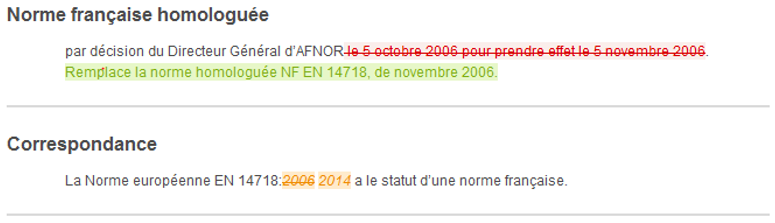
What is the Redline format?
The Redline + service - standards comparator allows you to easily and simply identify major changes between the current standard and its last canceled version.

At a glance, you will be able to identify the additions, deletions or modifications to a text, table, figure and formula.
At a glance, you will be able to identify the additions, deletions or modifications to a text, table, figure and formula

The Redlines + service is offered to you on the collection of French standards in force, in French language and in HTML and PDF format.

For an overview of the service, click on View a standard in redline format
Need to identify, monitor and decipher standards?

COBAZ is the simple and effective solution to meet the normative needs related to your activity, in France and abroad.

Available by subscription, CObaz is THE modular solution to compose according to your needs today and tomorrow. Quickly discover CObaz!

Request your free, no-obligation live demo

I discover COBAZ