

C33-012
C33-012

C33-012

December 1994
Standard Cancelled

Insulated cables and their accessories for power systems. Self-amalgamating insulating and semi-conducting tapes intended for cable accessories of rated voltages above 30 kv (um - 36 kv) and up to 150 kv (um = 170 kv).

Ce document définit des rubans auto-amalgamants isolants et semi-conducteurs destinés à la confection d'accessoires de câbles de tension assignées supérieures à 18/30(36) kV et inférieure ou égale à 87/150(170) W.

Main informations

Collections

National standards and national normative documents

Publication date

December 1994

Number of pages

23 p.

Reference

C33-012

ICS Codes

29.035.20   Plastics and rubber insulating materials
29.240.20   Power transmission and distribution lines

Classification index

C33-012

Print number

1 - janvier 1995
Sumary
Insulated cables and their accessories for power systems. Self-amalgamating insulating and semi-conducting tapes intended for cable accessories of rated voltages above 30 kv (um - 36 kv) and up to 150 kv (um = 170 kv).

Ce document définit des rubans auto-amalgamants isolants et semi-conducteurs destinés à la confection d'accessoires de câbles de tension assignées supérieures à 18/30(36) kV et inférieure ou égale à 87/150(170) W.
Standard replaced by (1)
NF C33-012
NF C33-012
August 2016
Standard Current
Insulated cables and their accessories for power Systems - Self-amalgamating insulating and semi-conducting tapes intended for cable accessories of rated voltages above 30 kV (Um = 36 kV) and up to 150 kV (Um = 170 kV)

AVANT-PROPOS 1 Généralités 2 Caractéristiques dimensionnelles 3 Caractéristiques de l'intercalaire 4 Caractéristiques physiques du ruban 5 Caractéristiques électrique 6 Vieillissement 7 Aptitude au stockage : Essai de stockage accéléré 8 Essais à effectuer sur chaque type de ruban 9 Conditionnement et repérage des rubans 10 Conditions de stockage et d'utilisation Annexe A (normative)Fiche d'identification des rubans auto-amalgamants Annexe B (normative)Essais à effectuer et sanctions pour chaque type de ruban

Table of contents
  • AVANT-PROPOS
    2
  • 1 GÉNÉRALITÉS
    5
  • 1.1 Domaine d'application
    5
  • 1.2 Références normatives
    5
  • 1.3 Dossier technique
    6
  • 1.4 Conditionnement des rouleaux destinés aux essais
    6
  • 2 CARACTÉRISTIQUES DIMENSIONNELLES
    6
  • 2.1 Épaisseur
    6
  • 2.2 Longueur
    6
  • 2.3 Largeur
    7
  • 2.4 Dimensions normalisées
    7
  • 3 CARACTÉRISTIQUES DE L'INTERCALAIRE
    7
  • 3.1 Force de décollement de l'intercalaire
    7
  • 3.2 Allongement à la rupture de l'intercalaire
    8
  • 4 CARACTÉRISTIQUES PHYSIQUES DU RUBAN
    9
  • 4.1 Pouvoir auto-amalgamant
    9
  • 4.2 Essai de retrait des rubans isolants
    10
  • 4.3 Caractéristiques en traction
    11
  • 4.4 Résistivité thermique apparente
    12
  • 5 CARACTÉRISTIQUES ÉLECTRIQUES
    16
  • 5.1 Rigidité diélectrique des rubans isolants
    16
  • 5.2 Permittivité et facteur de dissipation des rubans isolants
    16
  • 5.3 Résistivité électrique transversale des rubans isolants
    17
  • 5.4 Résistivité électrique transversale des rubans semi-conducteurs
    18
  • 6 VIEILLISSEMENT EN ÉTUVE
    20
  • 6.1 Éprouvettes
    20
  • 6.2 Mode opératoire
    20
  • 6.3 Mesures
    20
  • 6.4 Sanctions de l'essai
    20
  • 7 APTITUDE AU STOCKAGE: ESSAI DE STOCKAGE ACCÉLÉRÉ
    20
  • 7.1 Mode opératoire
    20
  • 7.2 Sanctions de l'essai
    20
  • 8 ESSAIS À EFFECTUER SUR CHAQUE TYPE DE RUBAN
    21
  • 9 CONDITIONNEMENT ET REPÉRAGE DES RUBANS
    21
  • 10 CONDITIONS DE STOCKAGE ET D'UTILISATION
    21
  • ANNEXE A - (normative) Fiche d'identification des rubans auto-amalgamants
    22
  • ANNEXE B - (normative) Essais à effectuer et sanctions pour chaque type de ruban
    23
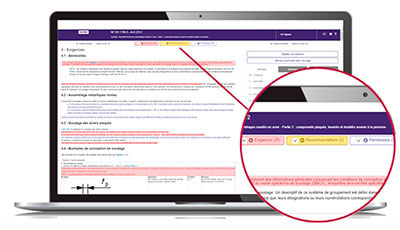
ZOOM ON ... the Requirements department

To comply with a standard, you need to quickly understand its issues in order to determine its impact on your activity.

The Requirements department helps you quickly locate within the normative text:

  • mandatory clauses to satisfy,
  • non-essential but useful clauses to know, such as permissions and recommendations.

The identification of these types of clauses is based on the document "ISO/IEC Directives, Part 2 - Principles and rules of structure and drafting of ISO documents" as well as on a constantly enriched list of verbal forms.

With Requirements, quickly access the main part of the normative text!


Need to identify, monitor and decipher standards?