
FD ETR 154
Digital Video Broadcasting (DVB). Implementation guidelines for the use of MPEG-2 systems. Video and audio in satellite and cable broadcasting applications.
Le présent document fournit des directives de mise en oeuvre pour l'utilisation du codage audiovisuel MPEG-2 dans les systèmes de diffusion par câble et par satellite, offrant une télévision numérique à résolution conventionnelle. Ne sont pas couvertes les applications du type diffusion terrestre, services interactifs ou télévision à haute définition.
- Avant-propos3
- Introduction4
-
1 Domaine d'application5
-
2 Références5
-
3 Définitions et abréviations5
-
3.1 Définitions5
-
3.2 Abréviations6
-
4 Couche systèmes6
-
4.1 Introduction (ISO/IEC 13818-1, article 0)7
-
4.2 Train élémentaire en paquets (TEP) (ISO/IEC 13818-1, paragraphe 0.4)7
-
4.3 Décodeur cible du système du train de transport (ISO/IEC 13818-1, paragraphe 2.4.2)7
-
4.4 Couche de paquet de transport (ISO/IEC 13818-1, paragraphe 2.4.3.2)7
-
4.5 Champ d'adaptation (ISO/IEC 13818-1, paragraphe 2.4.3.4)8
-
4.6 Paquet du Train élémentaire en paquets (TEP) (ISO/IEC 13818-1, paragraphe 2.4.3.6)9
-
4.7 Informations spécifiques de programme (ISP) (ISO/IEC 13818-1, paragraphe 2.4.4)10
-
4.8 Descripteurs de train élémentaire et de programme (ISO/IEC 13818-1, paragraphe 2.6)11
-
4.9 Compatibilité avec l'ISO/IEC 11172-1 (ISO/IEC 13818-1, paragraphe 2.8)13
-
5 Vidéo13
-
5.1 Profil et niveau13
-
5.2 Taux de trame14
-
5.3 Format d'image14
-
5.4 Résolution de la luminance15
-
5.5 Chrominance16
-
5.6 En-tête de séquence vidéo17
-
6 Audio17
-
6.1 Mode audio17
-
6.2 Couche de compression18
-
6.3 Débit binaire18
-
6.4 Fréquence d'échantillonnage18
-
6.5 Accentuation18
-
6.6 Contrôle de redondance cyclique18
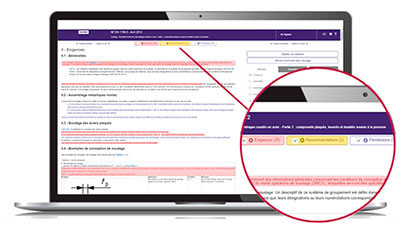
To comply with a standard, you need to quickly understand its issues in order to determine its impact on your activity.
The Requirements department helps you quickly locate within the normative text:
- mandatory clauses to satisfy,
- non-essential but useful clauses to know, such as permissions and recommendations.
The identification of these types of clauses is based on the document "ISO/IEC Directives, Part 2 - Principles and rules of structure and drafting of ISO documents" as well as on a constantly enriched list of verbal forms.
With Requirements, quickly access the main part of the normative text!

- The UPSELL service allows you to easily update one of your standards.
- With a single click, add a new language, the Requirements or Redline+ service and add one or more additional users.
- Whether you are in the process of acquiring a standard or it is already available in your personal space, the UPSELL service is available at every stage to help you understand it and implement it within your organization.
COBAZ is the simple and effective solution to meet the normative needs related to your activity, in France and abroad.
Available by subscription, CObaz is THE modular solution to compose according to your needs today and tomorrow. Quickly discover CObaz!
Request your free, no-obligation live demo
I discover COBAZ