
FD ISO/TR 12885
FD ISO/TR 12885

FD ISO/TR 12885

January 2020
Published document Current

Nanotechnologies - Health and safety practices in occupational settings

This document describes health and safety practices in occupational settings relevant to nanotechnologies. This document focuses on the occupational manufacture and use of manufactured nano-objects, and their aggregates and agglomerates greater than 100 nm (NOAAs). It does not address health and safety issues or practices associated with NOAAs generated by natural processes, hot processes and other standard operations which unintentionally generate NOAAs, or potential consumer exposures or uses, though some of the information in this document can be relevant to those areas.

Main informations

Collections

National standards and national normative documents

Thematics

QSE, Sécurité, Gestion des risques et SST

Publication date

January 2020

Number of pages

133 p.

Reference

FD ISO/TR 12885

ICS Codes

07.120   Nanotechnologies
13.100   Occupational safety. Industrial hygiene

Classification index

T16-307

Print number

1

International kinship

ISO/TR 12885:2018
Sumary
Nanotechnologies - Health and safety practices in occupational settings

This document describes health and safety practices in occupational settings relevant to nanotechnologies. This document focuses on the occupational manufacture and use of manufactured nano-objects, and their aggregates and agglomerates greater than 100 nm (NOAAs). It does not address health and safety issues or practices associated with NOAAs generated by natural processes, hot processes and other standard operations which unintentionally generate NOAAs, or potential consumer exposures or uses, though some of the information in this document can be relevant to those areas.

Replaced standards (1)
FD ISO/TR 12885
FD ISO/TR 12885
February 2014
Published document Cancelled
Nanotechnologies. Health and safety practices in occupational settings relevant to nanotechnologies

ISO/TR 12885:2008 describes health and safety practices in occupational settings relevant to nanotechnologies. ISO/TR 12885:2008 focuses on the occupational manufacture and use of engineered nanomaterials. It does not address health and safety issues or practices associated with nanomaterials generated by natural processes, hot processes and other standard operations which unintentionally generate nanomaterials, or potential consumer exposures or uses, though some of the information in ISO/TR 12885:2008 might be relevant to those areas. Use of the information in ISO/TR 12885:2008 could help companies, researchers, workers and other people to prevent adverse health and safety consequences during the production, handling, use and disposal of manufactured nanomaterials. This advice is broadly applicable across a range of nanomaterials and applications.

Table of contents
  • 1 Domaine d'application
  • 2 Références normatives
  • 3 Termes et définitions
  • 4 Symboles et abréviations
  • 5 Nanomatériaux: description et fabrication
  • 6 Caractérisation des dangers
  • 7 Évaluation de l'exposition aux nanomatériaux
  • 8 Évaluation des risques dans les milieux professionnels
  • 9 Approches de réduction des risques
  • Annexe A Composition chimique élémentaire des nanomatériaux
  • Annexe B Études de toxicité spécifiques aux nanomatériaux réalisées sur des cultures cellulaires ou des animaux
  • Annexe C Caractéristiques d'instruments et techniques sélectionnés pour la surveillance de l'exposition aux nano-aérosols
  • Annexe D Caractéristiques des enceintes de sécurité biologique
  • Annexe E Facteurs de protection attribués des appareils de protection respiratoire
  • Annexe F Avantages et inconvénients des différents types d'appareils de protection respiratoire avec filtre à particules
  • Bibliographie
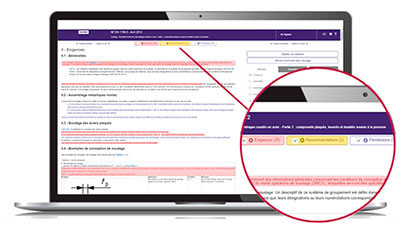
ZOOM ON ... the Requirements department

To comply with a standard, you need to quickly understand its issues in order to determine its impact on your activity.

The Requirements department helps you quickly locate within the normative text:

  • mandatory clauses to satisfy,
  • non-essential but useful clauses to know, such as permissions and recommendations.

The identification of these types of clauses is based on the document "ISO/IEC Directives, Part 2 - Principles and rules of structure and drafting of ISO documents" as well as on a constantly enriched list of verbal forms.

With Requirements, quickly access the main part of the normative text!


What is the Redline format?
New: UPSELL service
Need to identify, monitor and decipher standards?