

FD ISO/TR 14253-6
FD ISO/TR 14253-6

FD ISO/TR 14253-6

March 2013
Published document Current

Geometrical product specifications (GPS) - Inspection by measurement of workpieces and measuring equipment - Part 6 : generalized decision rules for the acceptance and rejection of instruments and workpieces

ISO/TR 14253-6:2012 expands the scope of decision rules to industrial situations where the default rule of ISO 14253-1 might not be economically optimal. (ISO 14253-1 provides a default decision rule having a very high probability that a measured value resulting in product acceptance also yields a product with the corresponding measurand conforming to specifications.)ISO/TR 14253-6:2012 does not address how to determine the cost of correct decisions (accepting conforming workpieces or rejecting nonconforming workpieces) or incorrect decisions (rejecting conforming workpieces or accepting nonconforming workpieces) as this is a business concern. However, the terminology and requirements to communicate and implement the particular decision rules desired by an organization are provided along with examples to guide the reader.

Main informations

Collections

National standards and national normative documents

Publication date

March 2013

Number of pages

24 p.

Reference

FD ISO/TR 14253-6

ICS Codes

17.040.01   Linear and angular measurements in general
17.040.40   Geometrical Product Specification (GPS)

Classification index

E10-201-6

Print number

1 - mars 2013

International kinship

ISO/TR 14253-6:2012
Sumary
Geometrical product specifications (GPS) - Inspection by measurement of workpieces and measuring equipment - Part 6 : generalized decision rules for the acceptance and rejection of instruments and workpieces

ISO/TR 14253-6:2012 expands the scope of decision rules to industrial situations where the default rule of ISO 14253-1 might not be economically optimal. (ISO 14253-1 provides a default decision rule having a very high probability that a measured value resulting in product acceptance also yields a product with the corresponding measurand conforming to specifications.)

ISO/TR 14253-6:2012 does not address how to determine the cost of correct decisions (accepting conforming workpieces or rejecting nonconforming workpieces) or incorrect decisions (rejecting conforming workpieces or accepting nonconforming workpieces) as this is a business concern. However, the terminology and requirements to communicate and implement the particular decision rules desired by an organization are provided along with examples to guide the reader.

Table of contents
  • Avant-propos
    iv
  • Introduction
    v
  • 1 Domaine d'application
    1
  • 2 Références normatives
    1
  • 3 Termes et définitions
    2
  • 4 Généralités
    5
  • 5 Règles de décision
    6
  • 5.1 Bandes de garde
    6
  • 5.2 Zones d'acceptation
    6
  • 5.3 Zones de rejet
    9
  • 5.4 Zones de transition
    9
  • 5.5 Exigences de règle de décision
    9
  • 6 Exemples de règles de décision
    10
  • 6.1 Généralités
    10
  • 6.2 Indice de capabilité du processus = 2/3 et indice de capabilité à la mesure = 2
    10
  • 6.3 Indice de capabilité du processus = 1 et indice de capabilité à la mesure = 4
    12
  • 6.4 Mesures sans distribution de production
    12
  • Annexe A (informative) Relation avec la matrice GPS
    14
  • Bibliographie
    16
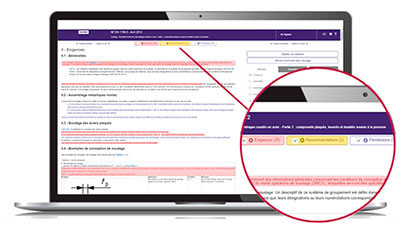
ZOOM ON ... the Requirements department

To comply with a standard, you need to quickly understand its issues in order to determine its impact on your activity.

The Requirements department helps you quickly locate within the normative text:

  • mandatory clauses to satisfy,
  • non-essential but useful clauses to know, such as permissions and recommendations.

The identification of these types of clauses is based on the document "ISO/IEC Directives, Part 2 - Principles and rules of structure and drafting of ISO documents" as well as on a constantly enriched list of verbal forms.

With Requirements, quickly access the main part of the normative text!


New: UPSELL service
Need to identify, monitor and decipher standards?