FD ISO/TR 22930-1

FD ISO/TR 22930-1

November 2020
Published document Current

Evaluating the performance of continuous air monitors - Part 1 : air monitors based on accumulation sampling techniques

The use of a continuous air monitor (CAM) is mainly motivated by the need to be alerted quickly and in the most accurate way possible with an acceptable false alarm rate when a significant activity concentration value is exceeded, in order to take appropriate measures to reduce exposure of those involved.The performance of this CAM does not only depend on the metrological aspect characterized by the decision threshold, the limit of detection and the measurement uncertainties but also on its dynamic capacity characterized by its response time as well as on the minimum detectable activity concentration corresponding to an acceptable false alarm rate.The ideal performance is to have a minimum detectable activity concentration as low as possible associated with a very short response time, but unfortunately these two criteria are in opposition. It is therefore important that the CAM and the choice of the adjustment parameters and the alarm levels be in line with the radiation protection objectives.The knowledge of a few factors is needed to interpret the response of a CAM and to select the appropriate CAM type and its operating parameters.Among those factors, it is important to know the half-lives of the radionuclides involved, in order to select the appropriate detection system and its associated model of evaluation.CAM using filter media accumulation sampling techniques are usually of two types:a) fixed filter;b) moving filter.This document first describes the theory of operation of each CAM type i.e.:— the different models of evaluation considering short or long radionuclides half-lives values,— the dynamic behaviour and the determination of the response time.In most case, CAM is used when radionuclides with important radiotoxicities are involved (small value of ALI). Those radionuclides have usually long half-life values.Then the determination of the characteristic limits (decision threshold, detection limit, limits of the coverage interval) of a CAM is described by the use of long half-life models of evaluation.Finally, a possible way to determine the minimum detectable activity concentration and the alarms setup is pointed out.The annexes of this document show actual examples of CAM data which illustrate how to quantify the CAM performance by determining the response time, the characteristics limits, the minimum detectable activity concentration and the alarms setup.
Main informations

Collections

National standards and national normative documents

Thematics

Gestion des risques et SST, Sécurité, QSE

Publication date

November 2020

Number of pages

58 p.

Reference

FD ISO/TR 22930-1

ICS Codes

13.040.30   Workplace atmospheres
13.280   Radiation protection

Classification index

M60-840-1

Print number

1

International kinship

Sumary
Evaluating the performance of continuous air monitors - Part 1 : air monitors based on accumulation sampling techniques

The use of a continuous air monitor (CAM) is mainly motivated by the need to be alerted quickly and in the most accurate way possible with an acceptable false alarm rate when a significant activity concentration value is exceeded, in order to take appropriate measures to reduce exposure of those involved.

The performance of this CAM does not only depend on the metrological aspect characterized by the decision threshold, the limit of detection and the measurement uncertainties but also on its dynamic capacity characterized by its response time as well as on the minimum detectable activity concentration corresponding to an acceptable false alarm rate.

The ideal performance is to have a minimum detectable activity concentration as low as possible associated with a very short response time, but unfortunately these two criteria are in opposition. It is therefore important that the CAM and the choice of the adjustment parameters and the alarm levels be in line with the radiation protection objectives.

The knowledge of a few factors is needed to interpret the response of a CAM and to select the appropriate CAM type and its operating parameters.

Among those factors, it is important to know the half-lives of the radionuclides involved, in order to select the appropriate detection system and its associated model of evaluation.

CAM using filter media accumulation sampling techniques are usually of two types:

a) fixed filter;

b) moving filter.

This document first describes the theory of operation of each CAM type i.e.:

— the different models of evaluation considering short or long radionuclides half-lives values,

— the dynamic behaviour and the determination of the response time.

In most case, CAM is used when radionuclides with important radiotoxicities are involved (small value of ALI). Those radionuclides have usually long half-life values.

Then the determination of the characteristic limits (decision threshold, detection limit, limits of the coverage interval) of a CAM is described by the use of long half-life models of evaluation.

Finally, a possible way to determine the minimum detectable activity concentration and the alarms setup is pointed out.

The annexes of this document show actual examples of CAM data which illustrate how to quantify the CAM performance by determining the response time, the characteristics limits, the minimum detectable activity concentration and the alarms setup.

Table of contents
  • 1 Domaine d'application
  • 2 Références normatives
  • 3 Termes et définitions
  • 4 Symboles
  • 5 Principe de mesure
  • 6 Dispositif de surveillance à support filtrant fixe
  • 7 Dispositif de surveillance à support filtrant déroulant
  • 8 Évaluation des limites caractéristiques
  • 9 Paramétrage des alarmes, activité volumique minimale détectable et EMP
  • Annexe A Exemple numérique de mesure de l'activité d'émission bêta globale sur un filtre fixe
  • Annexe B Exemple numérique de mesure de l'activité d'émission alpha globale sur un filtre déroulant
  • Annexe C Exemple numérique d'un mesurage par spectrométrie gamma de l'activité volumique de l'iode 131 sur une cartouche au charbon fixe
  • Annexe D Détermination de l'activité volumique détectable et de son temps de réponse associé en utilisant une méthode de régression linéaire et de test statistique
  • Bibliographie
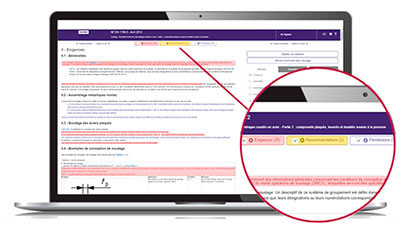
ZOOM ON ... the Requirements department
To comply with a standard, you need to quickly understand its issues in order to determine its impact on your activity.

The Requirements department helps you quickly locate within the normative text:
- mandatory clauses to satisfy,
- non-essential but useful clauses to know, such as permissions and recommendations.

The identification of these types of clauses is based on the document “ISO / IEC Directives, Part 2 - Principles and rules of structure and drafting of ISO documents ”as well as on a constantly enriched list of verbal forms.

With Requirements, quickly access the main part of the normative text!

With Requirements, quickly access the main part of the normative text!
New: UPSELL service
- The UPSELL service allows you to easily update one of your standards.
- With a single click, add a new language, the Requirements or Redline+ service and add one or more additional users.
- Whether you are in the process of acquiring a standard or it is already available in your personal space, the UPSELL service is available at every stage to help you understand it and implement it within your organization.
Need to identify, monitor and decipher standards?

COBAZ is the simple and effective solution to meet the normative needs related to your activity, in France and abroad.

Available by subscription, CObaz is THE modular solution to compose according to your needs today and tomorrow. Quickly discover CObaz!

Request your free, no-obligation live demo

I discover COBAZ