FD V03-116

FD V03-116

June 2001
Published document Current

Analysis of agricultural and food products - Guide for application of metrological data

Introduction 41 Terminologie 41.1 Terminologie 41.2 Terminologie à bannir 102 L'approche métrologie dans l'agro-alimentaire 112.1 Les objectifs des laboratoires d'analyse en agro-alimentaire 112.2 Le système analytique 122.3 La notion de "raccordement" et de "chaîne d'étalonnage" 132.4 Les différents types de méthodes analytiques 142.5 Étendue et fréquence des contrôles métrologiques 152.6 La maîtrise et la gestion des matériaux et substances de référence 162.7 Les essais d'aptitude des laboratoires 163 Établissement et interprétations des tolérances et des erreurs maximales tolérées : quelques exemples 173.1 Procédure de détermination des incertitudes de mesure 173.2 Recensement des sources d'incertitudes 193.3 Exemples d'estimation d'incertitudes par des méthodes de type B 203.4 Application du calcul des incertitudes dans le cas des méthodes d'analyses 213.5 Établissement des incertitudes - règles de décision 224 Position vis-à-vis des normes existantes 234.1 Comment interpréter les méthodes normalisées 234.2 Notion de capabilité 25Annexe A (informative) Loi d'additivité des variances 29Annexe B (informative) Quelques exemples d'incertitudes types calculées à partir des données fournies 30Bibliographie 47

Main informations

Collections

National standards and national normative documents

Publication date

June 2001

Number of pages

48 p.

Reference

FD V03-116

ICS Codes

17.020   Metrology and measurement in general
67.050   General methods of tests and analysis for food products
Sumary
Analysis of agricultural and food products - Guide for application of metrological data

Introduction 4

1 Terminologie 4

1.1 Terminologie 4

1.2 Terminologie à bannir 10

2 L'approche métrologie dans l'agro-alimentaire 11

2.1 Les objectifs des laboratoires d'analyse en agro-alimentaire 11

2.2 Le système analytique 12

2.3 La notion de "raccordement" et de "chaîne d'étalonnage" 13

2.4 Les différents types de méthodes analytiques 14

2.5 Étendue et fréquence des contrôles métrologiques 15

2.6 La maîtrise et la gestion des matériaux et substances de référence 16

2.7 Les essais d'aptitude des laboratoires 16

3 Établissement et interprétations des tolérances et des erreurs maximales tolérées : quelques exemples 17

3.1 Procédure de détermination des incertitudes de mesure 17

3.2 Recensement des sources d'incertitudes 19

3.3 Exemples d'estimation d'incertitudes par des méthodes de type B 20

3.4 Application du calcul des incertitudes dans le cas des méthodes d'analyses 21

3.5 Établissement des incertitudes - règles de décision 22

4 Position vis-à-vis des normes existantes 23

4.1 Comment interpréter les méthodes normalisées 23

4.2 Notion de capabilité 25

Annexe A (informative) Loi d'additivité des variances 29

Annexe B (informative) Quelques exemples d'incertitudes types calculées à partir des données fournies 30

Bibliographie 47

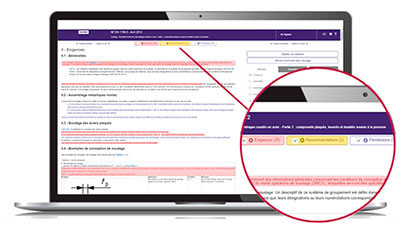
ZOOM ON ... the Requirements department
To comply with a standard, you need to quickly understand its issues in order to determine its impact on your activity.

The Requirements department helps you quickly locate within the normative text:
- mandatory clauses to satisfy,
- non-essential but useful clauses to know, such as permissions and recommendations.

The identification of these types of clauses is based on the document “ISO / IEC Directives, Part 2 - Principles and rules of structure and drafting of ISO documents ”as well as on a constantly enriched list of verbal forms.

With Requirements, quickly access the main part of the normative text!

With Requirements, quickly access the main part of the normative text!
New: UPSELL service
- The UPSELL service allows you to easily update one of your standards.
- With a single click, add a new language, the Requirements or Redline+ service and add one or more additional users.
- Whether you are in the process of acquiring a standard or it is already available in your personal space, the UPSELL service is available at every stage to help you understand it and implement it within your organization.
Need to identify, monitor and decipher standards?

COBAZ is the simple and effective solution to meet the normative needs related to your activity, in France and abroad.

Available by subscription, CObaz is THE modular solution to compose according to your needs today and tomorrow. Quickly discover CObaz!

Request your free, no-obligation live demo

I discover COBAZ