

GA X30-444
GA X30-444

GA X30-444

August 2005
Application guide Cancelled

Household and related refuse - Constitution and characterisation, on entering sorting centres, of a sample out of a batch of selectively collected household and related refuse - Application guide of experimental standard XP X30-437, February 2005

Main informations

Collections

National standards and national normative documents

Publication date

August 2005

Number of pages

26 p.

Reference

GA X30-444

ICS Codes

13.030.10   Solid wastes
13.030.50   Recycling

Classification index

X30-444

Print number

1 - juillet 2005
Standard replaced by (1)
GA X30-444
GA X30-444
June 2009
Application guide Current
Household and related refuse - Constitution and characterisation, on entering sorting centres, of a sample out of a batch of selectively collected household and related refuse - Application guide of standard NF X30-437, March 2009

Table of contents
  • 0 Introduction
    4
  • 1 Domaine d'application
    4
  • 2 Termes et définitions
    4
  • 3 Préparation de la campagne de prélèvements
    5
  • 3.1 Paramètres de prélèvements
    5
  • 3.2 Plan de prélèvement
    7
  • 3.3 Catégories et consignes de tri
    8
  • 4 Matériel
    10
  • 5 Prélèvement
    10
  • 5.1 Conditions
    10
  • 5.2 Mode opératoire pour réaliser le prélèvement
    11
  • 6 Caractérisation du prélèvement
    14
  • 6.1 Mise en ceuvre
    14
  • 6.2 Rapport de prélèvement
    15
  • 7 Rapport d'échantillonnage
    15
  • 7.1 Identification de l'échantillon
    15
  • 7.2 Détermination de la composition de l'échantillon
    15
  • 7.3 Exploitation des résultats
    15
  • Annexe A (informative) Catégories de déchets (exemple)
    16
  • Annexe B (informative) Exemple de rapport de prélèvement
    17
  • Bibliographie
    18
  • Annexe GA (informative) Synthèse des analyses par collectivité et par flux Exemple avec 18 prélèvements
    19
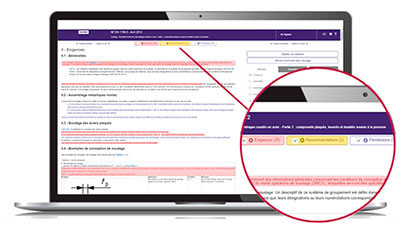
ZOOM ON ... the Requirements department

To comply with a standard, you need to quickly understand its issues in order to determine its impact on your activity.

The Requirements department helps you quickly locate within the normative text:

  • mandatory clauses to satisfy,
  • non-essential but useful clauses to know, such as permissions and recommendations.

The identification of these types of clauses is based on the document "ISO/IEC Directives, Part 2 - Principles and rules of structure and drafting of ISO documents" as well as on a constantly enriched list of verbal forms.

With Requirements, quickly access the main part of the normative text!


New: UPSELL service
Need to identify, monitor and decipher standards?