IEC 60079-10-2:2026
IEC 60079-10-2:2026

IEC 60079-10-2:2026

June 2026
International standard Current

Explosive atmospheres - Part 10-2: Classification of areas - Explosive dust atmospheres

IEC 60079-10-2 is concerned with the identification and classification of areas where explosive dust atmospheres and combustible dust layers are present in order to permit the proper assessment of ignition sources in such areas. In this document, explosive dust atmospheres and combustible dust layers are treated separately. In Clause 4, area classification for explosive dust clouds is described, with dust layers acting as one of the possible sources of release. In Clause 7, other general considerations for dust layers are described. The examples in this document are based on a system of effective housekeeping being implemented in the plant to prevent dust layers from accumulating. Where effective housekeeping is not present, the area classification includes the possible formation of explosive dust clouds from dust layers. The principles of this document can also be followed when combustible fibres or flyings might cause a hazard.Atmospheric conditions include variations in pressure and temperature above and below reference levels of 101,3 kPa (1 013 mbar) and 20 °C (293 K), provided that the variations have a negligible effect on the explosive properties of the combustible material. For air with normal oxygen content, typically a volume fraction of 21 % is assumed.It does not apply to:a) underground mining areas;b) dusts of explosives that do not require atmospheric oxygen for combustion such as pyrophoric substances, propellants, pyrotechnics, munitions, peroxides, oxidizers, water‑reactive elements or compounds, or other similar materials;c) catastrophic failures or rare malfunctions which are outside the conditions dealt with in this document;d) rooms used for medical purposes;e) domestic premises;f) where a hazard is due to the presence of flammable gas or vapour, but the principles can be used in the assessment of a hybrid mixture (see also IEC 60079-10-1).This document does not consider the effects of consequential damage following a fire or an explosion. Please refer to the foreword of the document for a detailed listing of the significant technical changes from the previous edition.


Main informations

Collections

International IEC standards

Thematics

QSE, Sécurité, Gestion des risques et SST

Publication date

June 2026

Number of pages

36 p.

Reference

IEC 60079-10-2:2026

ICS Codes

29.260.20   Electrical apparatus for explosive atmospheres
Sumary
Explosive atmospheres - Part 10-2: Classification of areas - Explosive dust atmospheres

IEC 60079-10-2 is concerned with the identification and classification of areas where explosive dust atmospheres and combustible dust layers are present in order to permit the proper assessment of ignition sources in such areas. In this document, explosive dust atmospheres and combustible dust layers are treated separately. In Clause 4, area classification for explosive dust clouds is described, with dust layers acting as one of the possible sources of release. In Clause 7, other general considerations for dust layers are described. The examples in this document are based on a system of effective housekeeping being implemented in the plant to prevent dust layers from accumulating. Where effective housekeeping is not present, the area classification includes the possible formation of explosive dust clouds from dust layers. The principles of this document can also be followed when combustible fibres or flyings might cause a hazard.
Atmospheric conditions include variations in pressure and temperature above and below reference levels of 101,3 kPa (1 013 mbar) and 20 °C (293 K), provided that the variations have a negligible effect on the explosive properties of the combustible material. For air with normal oxygen content, typically a volume fraction of 21 % is assumed.
It does not apply to:
a) underground mining areas;
b) dusts of explosives that do not require atmospheric oxygen for combustion such as pyrophoric substances, propellants, pyrotechnics, munitions, peroxides, oxidizers, water‑reactive elements or compounds, or other similar materials;
c) catastrophic failures or rare malfunctions which are outside the conditions dealt with in this document;
d) rooms used for medical purposes;
e) domestic premises;
f) where a hazard is due to the presence of flammable gas or vapour, but the principles can be used in the assessment of a hybrid mixture (see also IEC 60079-10-1).
This document does not consider the effects of consequential damage following a fire or an explosion. Please refer to the foreword of the document for a detailed listing of the significant technical changes from the previous edition.
Replaced standards (1)
IEC 60079-10-2:2015
IEC 60079-10-2:2015
January 2015
International standard Cancelled
Explosive atmospheres - Part 10-2: Classification of areas - Explosive dust atmospheres

IEC 60079-10-2:2015 is concerned with the identification and classification of areas where explosive dust atmospheres and combustible dust layers are present, in order to permit the proper assessment of ignition sources in such areas. In this standard, explosive dust atmospheres and combustible dust layers are treated separately. In Clause 4, area classification for explosive dusts clouds is described, with dust layers acting as one of the possible sources of release. In Clause 7 other general considerations for dust layers are described. The examples in this standard are based on a system of effective housekeeping being implemented in the plant to prevent dust layers from accumulating. Where effective housekeeping is not present, the area classification includes the possible formation of explosive dust clouds from dust layers. The principles of this standard can also be followed when combustible fibres or flyings might cause a hazard. This standard is intended to be applied where there can be a risk due to the presence of explosive dust atmospheres or combustible dust layers under normal atmospheric conditions. Please refer to the foreword of the document for a detailed listing of the significant technical changes from the previous edition. Keywords: explosive dust atmospheres, combustible dust layers, ignition hazards

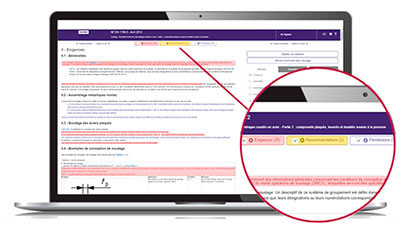
ZOOM ON ... the Requirements department
To comply with a standard, you need to quickly understand its issues in order to determine its impact on your activity.

The Requirements department helps you quickly locate within the normative text:
- mandatory clauses to satisfy,
- non-essential but useful clauses to know, such as permissions and recommendations.

The identification of these types of clauses is based on the document “ISO / IEC Directives, Part 2 - Principles and rules of structure and drafting of ISO documents ”as well as on a constantly enriched list of verbal forms.

With Requirements, quickly access the main part of the normative text!

With Requirements, quickly access the main part of the normative text!
Need to identify, monitor and decipher standards?