IEC 60287-1-1:2006
Electric cables - Calculation of the current rating - Part 1-1: Current rating equations (100 % load factor) and calculation of losses - General
Applicable to the conditions of steady-state operation of cables at all alternating voltages, and direct voltages up to 5 kV, buried directly in the ground, in ducts, troughs or in steel pipes, both with and without partial drying-out of the soil, as well as cables in air. The term "steady state" is intended to mean a continuous constant current (100 % load factor) just sufficient to produce asymptotically the maximum conductor temperature, the surrounding ambient conditions being assumed constant. Provides formulae for current ratings and losses. The formulae given are essentially literal and designedly leave open the selection of certain important parameters. These may be divided into three groups: - parameters related to construction of a cable (for example, thermal resistivity of insulating material) for which representative values have been selected based on published work; - parameters related to the surrounding conditions, which may vary widely, the selection of which depends on the country in which the cables are used or are to be used; - parameters which result from an agreement between manufacturer and user and which involve a margin for security of service (for example, maximum conductor temperature).


IEC 60287-1-1:2023 is applicable to the conditions of steady-state operation of cables at all alternating voltages, and direct voltages up to 5 kV, buried directly in the ground, in ducts, troughs or in steel pipes, both with and without partial drying-out of the soil, as well as cables in air. The term "steady state" is intended to mean a continuous constant current (100 % load factor) just sufficient to produce asymptotically the maximum conductor temperature, the surrounding ambient conditions being assumed constant. This document provides formulae for current ratings and losses. The formulae given are essentially literal and designedly leave open the selection of certain important parameters. These can be divided into three groups: - parameters related to construction of a cable (for example, thermal resistivity of insulating material) for which representative values have been selected based on published work; - parameters related to the surrounding conditions, which can vary widely, the selection of which depends on the country in which the cables are used or will be used; - parameters which result from an agreement between manufacturer and user and which involve a margin for security of service (for example, maximum conductor temperature).
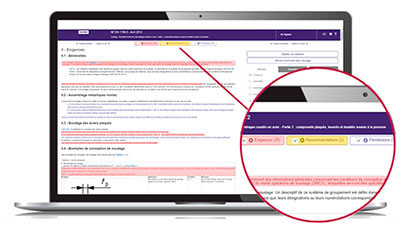
To comply with a standard, you need to quickly understand its issues in order to determine its impact on your activity.
The Requirements department helps you quickly locate within the normative text:
- mandatory clauses to satisfy,
- non-essential but useful clauses to know, such as permissions and recommendations.
The identification of these types of clauses is based on the document "ISO/IEC Directives, Part 2 - Principles and rules of structure and drafting of ISO documents" as well as on a constantly enriched list of verbal forms.
With Requirements, quickly access the main part of the normative text!

COBAZ is the simple and effective solution to meet the normative needs related to your activity, in France and abroad.
Available by subscription, CObaz is THE modular solution to compose according to your needs today and tomorrow. Quickly discover CObaz!
Request your free, no-obligation live demo
I discover COBAZ