IEC 60793-1-31:2019

IEC 60793-1-31:2019

February 2019
International standard Current

Optical fibres - Part 1-31: Measurement methods and test procedures - Tensile strength

IEC 60793-1-31:2019 provides values of the tensile strength under dynamic loading of optical fibre samples. The method tests individual lengths of uncabled and unbundled glass optical fibre. Sections of fibre are broken with controlled increasing stress or strain that is uniform over the entire fibre length and cross section. The stress or strain is increased at a nominally constant rate until breakage occurs. The distribution of the tensile strength values of a given fibre strongly depends on the sample length, loading velocity and environmental conditions. The test can be used for inspection where statistical data on fibre strength is required. Results are reported by means of statistical quality control distribution. Normally, the test is carried out after temperature and humidity conditioning of the sample. However, in some cases, it can be sufficient to measure the values at ambient temperature and humidity conditions. This method is applicable to categories A1, A2, and A3, and classes B and C optical fibres. The object of this document is to establish uniform requirements for the mechanical characteristic: tensile strength. This third edition cancels and replaces the second edition published in 2010. This edition constitutes a technical revision. This edition includes the following significant technical changes with respect to the previous edition:a) correction of Formulae (3b) and (4b) and renumbering of formulae.Keywords: tensile strength under dynamic loading of optical fibre samples

Main informations

Collections

International IEC standards

Publication date

February 2019

Number of pages

51 p.

Reference

IEC 60793-1-31:2019

ICS Codes

33.180.10   Fibres and cables
Sumary
Optical fibres - Part 1-31: Measurement methods and test procedures - Tensile strength

IEC 60793-1-31:2019 provides values of the tensile strength under dynamic loading of optical fibre samples. The method tests individual lengths of uncabled and unbundled glass optical fibre. Sections of fibre are broken with controlled increasing stress or strain that is uniform over the entire fibre length and cross section. The stress or strain is increased at a nominally constant rate until breakage occurs. The distribution of the tensile strength values of a given fibre strongly depends on the sample length, loading velocity and environmental conditions. The test can be used for inspection where statistical data on fibre strength is required. Results are reported by means of statistical quality control distribution. Normally, the test is carried out after temperature and humidity conditioning of the sample. However, in some cases, it can be sufficient to measure the values at ambient temperature and humidity conditions. This method is applicable to categories A1, A2, and A3, and classes B and C optical fibres. The object of this document is to establish uniform requirements for the mechanical characteristic: tensile strength. This third edition cancels and replaces the second edition published in 2010. This edition constitutes a technical revision. This edition includes the following significant technical changes with respect to the previous edition:
a) correction of Formulae (3b) and (4b) and renumbering of formulae.
Keywords: tensile strength under dynamic loading of optical fibre samples
Replaced standards (1)
International standard Cancelled
Optical fibres - Part 1-31: Measurement methods and test procedures - Tensile strength

IEC 60793-1-31:2010 provides values of the tensile strength of optical fibre samples and establishes uniform requirements for the mechanical characteristic - tensile strength. The main change with respect to the previous edition is the addition of comprehensive details, such as examples of fibre clamping as given in Annexes A, B and C.

ZOOM ON ... the Requirements department
To comply with a standard, you need to quickly understand its issues in order to determine its impact on your activity.

The Requirements department helps you quickly locate within the normative text:
- mandatory clauses to satisfy,
- non-essential but useful clauses to know, such as permissions and recommendations.

The identification of these types of clauses is based on the document “ISO / IEC Directives, Part 2 - Principles and rules of structure and drafting of ISO documents ”as well as on a constantly enriched list of verbal forms.

With Requirements, quickly access the main part of the normative text!
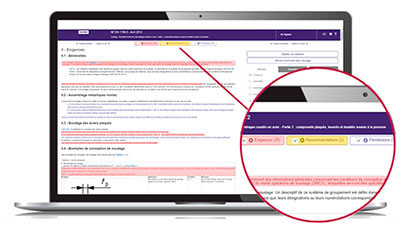
With Requirements, quickly access the main part of the normative text!

Need to identify, monitor and decipher standards?

COBAZ is the simple and effective solution to meet the normative needs related to your activity, in France and abroad.

Available by subscription, CObaz is THE modular solution to compose according to your needs today and tomorrow. Quickly discover CObaz!

Request your free, no-obligation live demo

I discover COBAZ