

IEC 60793-1-44:2011
IEC 60793-1-44:2011

IEC 60793-1-44:2011

April 2011
International standard Cancelled

Optical fibres - Part 1-44: Measurement methods and test procedures - Cut-off wavelength

IEC 60793-1-44:2011 establishes uniform requirements for measuring the cut-off wavelength of single-mode optical fibre, thereby assisting in the inspection of fibres and cables for commercial purposes. This standard gives the methods for measuring the cut-off wavelength of fibre and cable. This edition constitutes a technical revision. The main change with respect to the previous edition is the withdrawal of Annex D.This publication is to be read in conjunction with IEC 60793-1-1:2008.

Main informations

Collections

International IEC standards

Publication date

April 2011

Number of pages

44 p.

Reference

IEC 60793-1-44:2011

ICS Codes

33.180.10   Fibres and cables

Print number

1
Sumary
Optical fibres - Part 1-44: Measurement methods and test procedures - Cut-off wavelength

IEC 60793-1-44:2011 establishes uniform requirements for measuring the cut-off wavelength of single-mode optical fibre, thereby assisting in the inspection of fibres and cables for commercial purposes. This standard gives the methods for measuring the cut-off wavelength of fibre and cable. This edition constitutes a technical revision. The main change with respect to the previous edition is the withdrawal of Annex D.

This publication is to be read in conjunction with IEC 60793-1-1:2008.
Replaced standards (1)
IEC 60793-1-44:2001
International standard Cancelled
Optical fibres - Part 1-44: Measurement methods and test procedures - Cut-off wavelength

Provides methods for measuring the cut-off wavelength of single-mode optical fibres. The test method applies to a sample fibre in either an uncabled condition, or in a cable, or as a jumper cable. All methods require a reference measurement, with either a bend-reference technique or a multimode-reference technique.

Standard replaced by (1)
IEC 60793-1-44:2023
International standard Current
Optical fibres - Part 1-44: Measurement methods and test procedures - Cut-off wavelength

IEC 60793-1-44:2023 establishes uniform requirements for measuring the cut-off wavelength of single-mode optical fibre, thereby assisting in the inspection of fibres and cables for commercial purposes. This document gives methods for measuring the cut-off wavelength for uncabled or cabled single mode telecom fibre. These procedures apply to all category B and C fibre types. There are three methods of deployment for measuring the cut-off wavelength: - method A: cable cut-off using uncabled fibre 22 m long sample, lcc; - method B: cable cut-off using cabled fibre 22 m long sample, lcc; - method C: fibre cut-off using uncabled fibre 2 m long sample, lc. All methods require a reference measurement. There are two reference-scan techniques, either or both of which can be used with all methods: - bend-reference technique; - multimode-reference technique using category A1(OM1-OM5) multimode fibre. This third edition cancels and replaces the second edition published in 2011. This edition constitutes a technical revision. This edition includes the following significant technical changes with respect to the previous edition: a) used the diameter of the fibre loops to describe deployment; b) added Annex D related to cut-off curve artifacts; c) reorganized information and added more figures to clarify concepts.

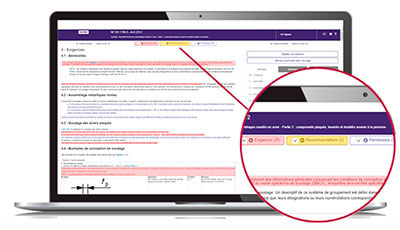
ZOOM ON ... the Requirements department

To comply with a standard, you need to quickly understand its issues in order to determine its impact on your activity.

The Requirements department helps you quickly locate within the normative text:

  • mandatory clauses to satisfy,
  • non-essential but useful clauses to know, such as permissions and recommendations.

The identification of these types of clauses is based on the document "ISO/IEC Directives, Part 2 - Principles and rules of structure and drafting of ISO documents" as well as on a constantly enriched list of verbal forms.

With Requirements, quickly access the main part of the normative text!


Need to identify, monitor and decipher standards?