

IEC 61000-4-33:2005
IEC 61000-4-33:2005

IEC 61000-4-33:2005

September 2005
International standard Current

Electromagnetic compatibility (EMC) - Part 4-33: Testing and measurement techniques - Measurement methods for high-power transient parameters

Provides a basic description of the methods and means (e.g., instrumentation) for measuring responses arising from high-power transient electromagnetic parameters. These responses can include: - the electric (E) and/or magnetic (H) fields (e.g., incident fields or incident plus scattered fields within a system under test); - the current I (e.g., induced by a transient field or within a system under test); - the voltage V (e.g., induced by a transient field or within a system under test); - the charge Q induced on a cable or other conductor. These measured quantities are generally complicated time-dependent waveforms, which can be described approximately by several scalar parameters, or "observables". These parameters include: - the peak amplitude of the response, - the waveform rise-time, - the pulse width, and - mathematically defined norms obtained from the waveform. This International Standard provides information on the measurement of these waveforms and on the mathematical determination of the characterizing parameters. It does not provide information on specific level requirements for testing. It has the status of a basic EMC publication in accordance with IEC Guide 107.

Main informations

Collections

International IEC standards

Publication date

September 2005

Number of pages

69 p.

Reference

IEC 61000-4-33:2005

ICS Codes

33.100.10   Emission
33.100.20   Immunity
Sumary
Electromagnetic compatibility (EMC) - Part 4-33: Testing and measurement techniques - Measurement methods for high-power transient parameters

Provides a basic description of the methods and means (e.g., instrumentation) for measuring responses arising from high-power transient electromagnetic parameters. These responses can include: - the electric (E) and/or magnetic (H) fields (e.g., incident fields or incident plus scattered fields within a system under test); - the current I (e.g., induced by a transient field or within a system under test); - the voltage V (e.g., induced by a transient field or within a system under test); - the charge Q induced on a cable or other conductor. These measured quantities are generally complicated time-dependent waveforms, which can be described approximately by several scalar parameters, or "observables". These parameters include: - the peak amplitude of the response, - the waveform rise-time, - the pulse width, and - mathematically defined norms obtained from the waveform. This International Standard provides information on the measurement of these waveforms and on the mathematical determination of the characterizing parameters. It does not provide information on specific level requirements for testing. It has the status of a basic EMC publication in accordance with IEC Guide 107.
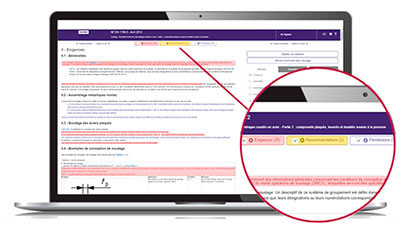
ZOOM ON ... the Requirements department

To comply with a standard, you need to quickly understand its issues in order to determine its impact on your activity.

The Requirements department helps you quickly locate within the normative text:

  • mandatory clauses to satisfy,
  • non-essential but useful clauses to know, such as permissions and recommendations.

The identification of these types of clauses is based on the document "ISO/IEC Directives, Part 2 - Principles and rules of structure and drafting of ISO documents" as well as on a constantly enriched list of verbal forms.

With Requirements, quickly access the main part of the normative text!


Need to identify, monitor and decipher standards?