

IEC 61078:2016

IEC 61078:2016

August 2016
International standard Current

Reliability block diagrams

IEC 61078:2016 this International Standard describes:- the requirements to apply when reliability block diagrams (RBDs) are used in dependability analysis;- the procedures for modelling the dependability of a system with reliability block diagrams;- how to use RBDs for qualitative and quantitative analysis;- the procedures for using the RBD model to calculate availability, failure frequency and reliability measures for different types of systems with constant (or time dependent) probabilities of blocks success/failure, and for non-repaired blocks or repaired blocks;- some theoretical aspects and limitations in performing calculations for availability, failure frequency and reliability measures;- the relationships with fault tree analysis (see IEC 61025) and Markov techniques (see IEC 61165). This third edition cancels and replaces the second edition published in 2006. This edition constitutes a technical revision. This edition includes the following significant technical changes with respect to the previous edition:- the structure of the document has been entirely reconsidered, the title modified and the content extended and improved to provide more information about availability, reliability and failure frequency calculations;- Clause 3 has been extended and clauses have been introduced to describe the electrical analogy, the "non-coherent" RBDs and the "dynamic" RBDs;- Annex B about Boolean algebra methods has been extended;- Annex C (Calculations of time dependent probabilities), Annex D (Importance factors), Annex E (RBD driven Petri net models) and Annex F (Numerical examples and curves) have been introduced. Keywords: reliability block diagram (RBD)

Main informations

Collections

International IEC standards

Publication date

August 2016

Number of pages

250 p.

Reference

IEC 61078:2016

ICS Codes

03.120.99   Other standards related to quality
03.120.01   Quality in general
Sumary
Reliability block diagrams

IEC 61078:2016 this International Standard describes:
- the requirements to apply when reliability block diagrams (RBDs) are used in dependability analysis;
- the procedures for modelling the dependability of a system with reliability block diagrams;
- how to use RBDs for qualitative and quantitative analysis;
- the procedures for using the RBD model to calculate availability, failure frequency and reliability measures for different types of systems with constant (or time dependent) probabilities of blocks success/failure, and for non-repaired blocks or repaired blocks;
- some theoretical aspects and limitations in performing calculations for availability, failure frequency and reliability measures;
- the relationships with fault tree analysis (see IEC 61025) and Markov techniques (see IEC 61165). This third edition cancels and replaces the second edition published in 2006. This edition constitutes a technical revision. This edition includes the following significant technical changes with respect to the previous edition:
- the structure of the document has been entirely reconsidered, the title modified and the content extended and improved to provide more information about availability, reliability and failure frequency calculations;
- Clause 3 has been extended and clauses have been introduced to describe the electrical analogy, the "non-coherent" RBDs and the "dynamic" RBDs;
- Annex B about Boolean algebra methods has been extended;
- Annex C (Calculations of time dependent probabilities), Annex D (Importance factors), Annex E (RBD driven Petri net models) and Annex F (Numerical examples and curves) have been introduced. Keywords: reliability block diagram (RBD)
Replaced standards (1)
IEC 61078:2006
January 2006
International standard Cancelled
Analysis techniques for dependability - Reliability block diagram and boolean methods

This International Standard describes procedures for modelling the dependability of a system and for using the model in order to calculate reliability and availability measures. The RBD modelling technique is intended to be applied primarily to systems without repair and where the order in which failures occur does not matter. For systems where the order of failures is to be taken into account or where repairs are to be carried out, other modelling techniques, such as Markov analysis, are more suitable.

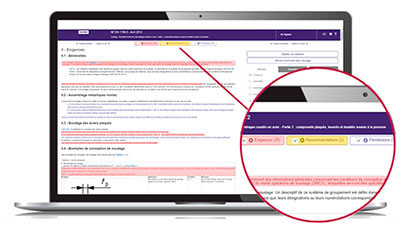
ZOOM ON ... the Requirements department
To comply with a standard, you need to quickly understand its issues in order to determine its impact on your activity.

The Requirements department helps you quickly locate within the normative text:
- mandatory clauses to satisfy,
- non-essential but useful clauses to know, such as permissions and recommendations.

The identification of these types of clauses is based on the document “ISO / IEC Directives, Part 2 - Principles and rules of structure and drafting of ISO documents ”as well as on a constantly enriched list of verbal forms.

With Requirements, quickly access the main part of the normative text!

With Requirements, quickly access the main part of the normative text!
Need to identify, monitor and decipher standards?

COBAZ is the simple and effective solution to meet the normative needs related to your activity, in France and abroad.

Available by subscription, CObaz is THE modular solution to compose according to your needs today and tomorrow. Quickly discover CObaz!

Request your free, no-obligation live demo

I discover COBAZ