
IEC 61165:2006
IEC 61165:2006

IEC 61165:2006

May 2006
International standard Current

Application of Markov techniques

This International Standard provides guidance on the application of Markov techniques to model and analyze a system and estimate reliability, availability, maintainability and safety measures. This standard is applicable to all industries where systems, which exhibit state-dependent behaviour, have to be analyzed. The Markov techniques covered by this standard assume constant time-independent state transition rates. Such techniques are often called homogeneous Markov techniques.

Main informations

Collections

International IEC standards

Publication date

May 2006

Number of pages

67 p.

Reference

IEC 61165:2006

ICS Codes

03.120.30   Application of statistical methods
03.120.01   Quality in general
21.020   Characteristics and design of machines, apparatus, equipment
Sumary
Application of Markov techniques

This International Standard provides guidance on the application of Markov techniques to model and analyze a system and estimate reliability, availability, maintainability and safety measures. This standard is applicable to all industries where systems, which exhibit state-dependent behaviour, have to be analyzed. The Markov techniques covered by this standard assume constant time-independent state transition rates. Such techniques are often called homogeneous Markov techniques.
Replaced standards (1)
IEC 61165:1995
IEC 61165:1995
January 1995
International standard Cancelled
Application of Markov techniques

Not only are Markov analysis methods suited to the modelling of maintenance strategies, but such methods also enable the failure restoration events to be modelled in a pictorial way which is in itself a valuable feature.

ZOOM ON ... the Requirements department

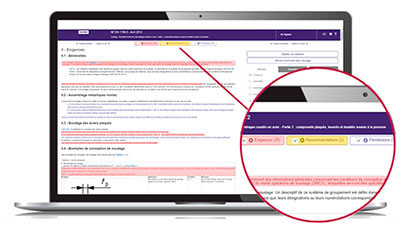
To comply with a standard, you need to quickly understand its issues in order to determine its impact on your activity.

The Requirements department helps you quickly locate within the normative text:

  • mandatory clauses to satisfy,
  • non-essential but useful clauses to know, such as permissions and recommendations.

The identification of these types of clauses is based on the document "ISO/IEC Directives, Part 2 - Principles and rules of structure and drafting of ISO documents" as well as on a constantly enriched list of verbal forms.

With Requirements, quickly access the main part of the normative text!


Need to identify, monitor and decipher standards?