IEC 62217:2025
IEC 62217:2025

IEC 62217:2025

October 2025
International standard Current

Polymeric HV insulators for indoor and outdoor use - General definitions, test methods and acceptance criteria

IEC 62217:2025 is applicable to polymeric insulators for AC systems with a nominal voltage greater than 1 000 V (frequency less than 100 Hz) and DC systems with a nominal voltage greater than 1 500 V whose insulating body consists of one or various organic materials. Polymeric insulators covered by this document are intended for use both on HV overhead lines and in substations, in both indoor and outdoor applications. They include composite insulators with solid and hollow core and resin insulators. Hybrid insulators with ceramic core and polymeric housing are also included, while coated insulators (e.g. with RTV silicone rubber coatings) are not included in this standard. Electrical tests described in this document are done under AC voltage and are in general applicable to insulators to be used in DC systems too. Tests under DC voltage are intended to reflect up-to-date knowledge and experience. Only polymeric housing materials of hybrid insulators are specified in this document. Tests for core materials and the interfaces between housing and core of hybrid insulators are not included.The object of this document is- to define the common terms used for polymeric insulators;- to prescribe common test methods for design tests on polymeric insulators;- to prescribe acceptance or failure criteria, if applicable;These tests, criteria and recommendations are intended to ensure a satisfactory lifetime under normal operating and environmental conditions. This document includes design tests intended to reject materials or designs which are inadequate under normal operating and environmental conditions. This document defines test methods and acceptance criteria. The applicable tests are given in the relevant product standard. This third edition cancels and replaces the second edition published in 2012. This edition constitutes a technical revision.This edition includes the following significant technical changes with respect to the previous edition:a) The scope of the document is specified to comprise composite insulators with solid and hollow core and resin insulators used for both AC and DC systems in indoor and outdoor applications of HV overhead lines and substations; hybrid insulators (defined in IEC TS 62896) with ceramic core and polymeric housing are also included, while coated insulators (e.g. with Room Temperature Vulcanized (RTV) silicone rubber coatings) are not considered in this document;b) Steep-front impulse voltage test is modified to avoid unwanted flashovers between the leads of the electrodes;c) Differences between hydrophobicity transfer material (HTM) and non-HTM housing materials are specified and relevant test methods and acceptance criteria for polymeric insulators with HTM housing are introduced;d) The previous water diffusion test on core materials with or without housing is split into two tests. One is on core materials without housing, the other is on core materials with housing. The acceptance criteria are modified;e) Stress corrosion test for core materials is introduced;f) Annex B summarizes the test application for evaluating the quality of interfaces and connections of end fittings, housing materials and core materials;g) Annex E is introduced to emphasize the need for control of electric fields of polymeric insulators for AC. The control of electric fields of polymeric insulators for DC is still under consideration.

Main informations

Collections

International IEC standards

Publication date

October 2025

Number of pages

72 p.

Reference

IEC 62217:2025

ICS Codes

29.080.10   Insulators
Sumary
Polymeric HV insulators for indoor and outdoor use - General definitions, test methods and acceptance criteria

IEC 62217:2025 is applicable to polymeric insulators for AC systems with a nominal voltage greater than 1 000 V (frequency less than 100 Hz) and DC systems with a nominal voltage greater than 1 500 V whose insulating body consists of one or various organic materials. Polymeric insulators covered by this document are intended for use both on HV overhead lines and in substations, in both indoor and outdoor applications. They include composite insulators with solid and hollow core and resin insulators. Hybrid insulators with ceramic core and polymeric housing are also included, while coated insulators (e.g. with RTV silicone rubber coatings) are not included in this standard. Electrical tests described in this document are done under AC voltage and are in general applicable to insulators to be used in DC systems too. Tests under DC voltage are intended to reflect up-to-date knowledge and experience. Only polymeric housing materials of hybrid insulators are specified in this document. Tests for core materials and the interfaces between housing and core of hybrid insulators are not included.
The object of this document is
- to define the common terms used for polymeric insulators;
- to prescribe common test methods for design tests on polymeric insulators;
- to prescribe acceptance or failure criteria, if applicable;
These tests, criteria and recommendations are intended to ensure a satisfactory lifetime under normal operating and environmental conditions. This document includes design tests intended to reject materials or designs which are inadequate under normal operating and environmental conditions. This document defines test methods and acceptance criteria. The applicable tests are given in the relevant product standard. This third edition cancels and replaces the second edition published in 2012. This edition constitutes a technical revision.
This edition includes the following significant technical changes with respect to the previous edition:
a) The scope of the document is specified to comprise composite insulators with solid and hollow core and resin insulators used for both AC and DC systems in indoor and outdoor applications of HV overhead lines and substations; hybrid insulators (defined in IEC TS 62896) with ceramic core and polymeric housing are also included, while coated insulators (e.g. with Room Temperature Vulcanized (RTV) silicone rubber coatings) are not considered in this document;
b) Steep-front impulse voltage test is modified to avoid unwanted flashovers between the leads of the electrodes;
c) Differences between hydrophobicity transfer material (HTM) and non-HTM housing materials are specified and relevant test methods and acceptance criteria for polymeric insulators with HTM housing are introduced;
d) The previous water diffusion test on core materials with or without housing is split into two tests. One is on core materials without housing, the other is on core materials with housing. The acceptance criteria are modified;
e) Stress corrosion test for core materials is introduced;
f) Annex B summarizes the test application for evaluating the quality of interfaces and connections of end fittings, housing materials and core materials;
g) Annex E is introduced to emphasize the need for control of electric fields of polymeric insulators for AC. The control of electric fields of polymeric insulators for DC is still under consideration.
Replaced standards (1)
IEC 62217:2012
September 2012
International standard Cancelled
Polymeric HV insulators for indoor and outdoor use - General definitions, test methods and acceptance criteria

IEC 62217:2012 is applicable to polymeric insulators whose insulating body consists of one or various organic materials. Polymeric insulators covered by this standard include both solid core and hollow insulators. They are intended for use on HV overhead lines and in indoor and outdoor equipment. The object of this standard is: - to define the common terms used for polymeric insulators; - to prescribe common test methods for design tests on polymeric insulators; - to prescribe acceptance or failure criteria, if applicable. These tests, criteria and recommendations are intended to ensure a satisfactory life-time under normal operating and environmental conditions. This standard shall only be applied in conjunction with the relevant product standard. This second edition cancels and replaces the first edition published in 2005. This edition constitutes a technical revision. This edition includes a significant technical change with respect to the previous edition. The first edition of IEC 62217 (2005) included two other alternative tracking and erosion tests (a 5 000 hour multi-stress test and a tracking wheel test) which were based on tests developed by CIGRE and utilities. These tests are no longer given as normative alternatives following the results of a study/questionnaire by TC 36 on the relative merits of all three tracking and erosion tests. The 5 000 hour multi-stress test and a tracking wheel test are described in IEC/TR 62730 (2012).

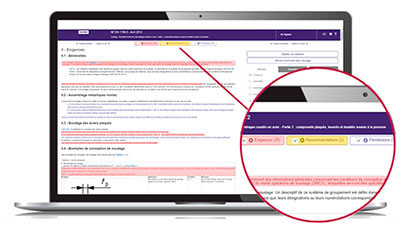
ZOOM ON ... the Requirements department
To comply with a standard, you need to quickly understand its issues in order to determine its impact on your activity.

The Requirements department helps you quickly locate within the normative text:
- mandatory clauses to satisfy,
- non-essential but useful clauses to know, such as permissions and recommendations.

The identification of these types of clauses is based on the document “ISO / IEC Directives, Part 2 - Principles and rules of structure and drafting of ISO documents ”as well as on a constantly enriched list of verbal forms.

With Requirements, quickly access the main part of the normative text!

With Requirements, quickly access the main part of the normative text!
Need to identify, monitor and decipher standards?

COBAZ is the simple and effective solution to meet the normative needs related to your activity, in France and abroad.

Available by subscription, CObaz is THE modular solution to compose according to your needs today and tomorrow. Quickly discover CObaz!

Request your free, no-obligation live demo

I discover COBAZ