IEC TR 61000-1-3:2002

IEC TR 61000-1-3:2002

June 2002
Technical report Current

Electromagnetic compatibility (EMC) - Part 1-3: General - The effects of high-altitude EMP (HEMP) on civil equipment and systems

The purpose of this Technical Report is to describe the effects that have occurred during actual and simulated electromagnetic pulse testing throughout the world. These effects include those observed during the high-altitude nuclear tests conducted by the United States and the Soviet Union in 1962, and the HEMP simulator tests conducted by many countries during the years after atmospheric testing ended. In addition to direct effects, this technical report also contains information on HEMP coupling to "long lines" as it is important to verify that particular levels of currents and voltages can be induced by HEMP on these lines; this provides a basis for direct injection testing of electronic equipment. It should be noted that, in most cases, the electrical equipment tested or exposed did not contain the sensitive electronics in use today. Also it should be emphasized that all tests and exposures did not produce failure of the equipment; factors such as the geometry of the HEMP interaction and the electromagnetic shielding of the equipment are variables that can produce differing results. The description of these effects is intended to illustrate the seriousness of the possible effects of HEMP on modern electronic systems.

Main informations

Collections

International IEC standards

Publication date

June 2002

Number of pages

46 p.

Reference

IEC TR 61000-1-3:2002

ICS Codes

33.100.99   Other aspects related to EMC
Sumary
Electromagnetic compatibility (EMC) - Part 1-3: General - The effects of high-altitude EMP (HEMP) on civil equipment and systems

The purpose of this Technical Report is to describe the effects that have occurred during actual and simulated electromagnetic pulse testing throughout the world. These effects include those observed during the high-altitude nuclear tests conducted by the United States and the Soviet Union in 1962, and the HEMP simulator tests conducted by many countries during the years after atmospheric testing ended. In addition to direct effects, this technical report also contains information on HEMP coupling to "long lines" as it is important to verify that particular levels of currents and voltages can be induced by HEMP on these lines; this provides a basis for direct injection testing of electronic equipment. It should be noted that, in most cases, the electrical equipment tested or exposed did not contain the sensitive electronics in use today. Also it should be emphasized that all tests and exposures did not produce failure of the equipment; factors such as the geometry of the HEMP interaction and the electromagnetic shielding of the equipment are variables that can produce differing results. The description of these effects is intended to illustrate the seriousness of the possible effects of HEMP on modern electronic systems.
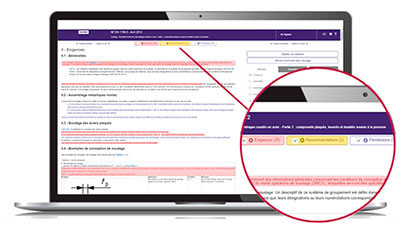
ZOOM ON ... the Requirements department

To comply with a standard, you need to quickly understand its issues in order to determine its impact on your activity.

The Requirements department helps you quickly locate within the normative text:

  • mandatory clauses to satisfy,
  • non-essential but useful clauses to know, such as permissions and recommendations.

The identification of these types of clauses is based on the document "ISO/IEC Directives, Part 2 - Principles and rules of structure and drafting of ISO documents" as well as on a constantly enriched list of verbal forms.

With Requirements, quickly access the main part of the normative text!

Need to identify, monitor and decipher standards?