IEC TR 61641:2014
IEC TR 61641:2014

IEC TR 61641:2014

September 2014
Technical report Cancelled

Enclosed low-voltage switchgear and controlgear assemblies - Guide for testing under conditions of arcing due to internal fault

IEC TR 61641:2014 gives guidance on the method of testing of ASSEMBLIES under conditions of arcing in air due to an internal fault. The purpose of this test is to assess the ability of the ASSEMBLY to limit the risk of personal injury, damage of ASSEMBLIES and its suitability for further service as a result of an internal arcing fault. This third edition cancels and replaces the second edition published in 2008. It constitutes a technical revision. This third edition includes the following significant technical changes with respect to the previous edition:- arcing classes to define the different forms of protection provided against arcing faults; (i) personnel protection, (ii) damage restricted to part of the ASSEMBLY, and (iii) ASSEMBLY suitable for limited further service.;- two levels of personnel protection afforded by ASSEMBLIES under arcing fault conditions; (i) for ASSEMBLIES installed in areas where access to the ASSEMBLY is restricted to skilled persons, and (ii) for ASSEMBLIES installed in areas where the area is accessible to ordinary persons;- option of individually insulating all live conductors to make the complete ASSEMBLY an arc ignition protected zone (referred to as an 'arc free zone' in previous editions of the Technical report);- arc fault protection front, back and sides of an ASSEMBLY as the normal requirement;- minimum performance requirements for arc ignition protected zone.

Main informations

Collections

International IEC standards

Publication date

September 2014

Number of pages

46 p.

Reference

IEC TR 61641:2014

ICS Codes

29.130.20   Low voltage switchgear and controlgear
Sumary
Enclosed low-voltage switchgear and controlgear assemblies - Guide for testing under conditions of arcing due to internal fault

IEC TR 61641:2014 gives guidance on the method of testing of ASSEMBLIES under conditions of arcing in air due to an internal fault. The purpose of this test is to assess the ability of the ASSEMBLY to limit the risk of personal injury, damage of ASSEMBLIES and its suitability for further service as a result of an internal arcing fault. This third edition cancels and replaces the second edition published in 2008. It constitutes a technical revision. This third edition includes the following significant technical changes with respect to the previous edition:
- arcing classes to define the different forms of protection provided against arcing faults; (i) personnel protection, (ii) damage restricted to part of the ASSEMBLY, and (iii) ASSEMBLY suitable for limited further service.;
- two levels of personnel protection afforded by ASSEMBLIES under arcing fault conditions; (i) for ASSEMBLIES installed in areas where access to the ASSEMBLY is restricted to skilled persons, and (ii) for ASSEMBLIES installed in areas where the area is accessible to ordinary persons;
- option of individually insulating all live conductors to make the complete ASSEMBLY an arc ignition protected zone (referred to as an 'arc free zone' in previous editions of the Technical report);
- arc fault protection front, back and sides of an ASSEMBLY as the normal requirement;
- minimum performance requirements for arc ignition protected zone.
Replaced standards (1)
IEC TR 61641:2008
IEC TR 61641:2008
January 2008
Technical report Cancelled
Enclosed low-voltage switchgear and controlgear assemblies - Guide for testing under conditions of arcing due to internal fault

This technical report applies to enclosed low-voltage switchgear and controlgear assemblies hereafter called ASSEMBLIES manufactured according to IEC 60439-1. This second edition cancels and replaces the first edition (1996) and constitutes a technical revision. The main change introduced in this new edition is the following: the concept of ASSEMBLY protection under arcing conditions has been introduced.

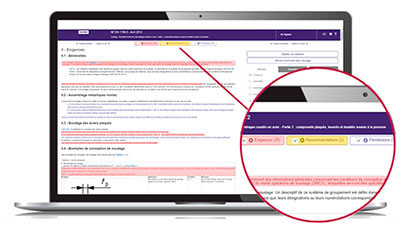
ZOOM ON ... the Requirements department

To comply with a standard, you need to quickly understand its issues in order to determine its impact on your activity.

The Requirements department helps you quickly locate within the normative text:

  • mandatory clauses to satisfy,
  • non-essential but useful clauses to know, such as permissions and recommendations.

The identification of these types of clauses is based on the document "ISO/IEC Directives, Part 2 - Principles and rules of structure and drafting of ISO documents" as well as on a constantly enriched list of verbal forms.

With Requirements, quickly access the main part of the normative text!

Need to identify, monitor and decipher standards?