ISO 10218-1:2025
ISO 10218-1:2025

ISO 10218-1:2025

February 2025
International standard Current

Robotics - Safety requirements - Part 1: Industrial robots

This document specifies requirements for the inherently safe design, risk reduction measures and information for use of robots for an industrial environment.This document addresses the robot as an incomplete machine.This document is not applicable to the following uses and products:?     underwater;?     law enforcement;?     military (defence);?     airborne and space robots, including outer space;?     medical robots;?     healthcare robots;?     prosthetics and other aids for the physically impaired;?     service robots, which provide a service to a person and as such where the public can have access;?     consumer products, as this is household use to which the public can have access;?     lifting or transporting people.NOTE 1        Requirements for robot integration and robot applications are covered in ISO 10218-2:2025.NOTE 2        Additional hazards can be created by robot applications (e.g. welding, laser cutting, machining). These hazards are addressed during robot application design. See ISO 10218-2:2025.This document deals with the significant hazards, hazardous situations or hazardous events when used as intended and under specified conditions of misuse which are reasonably foreseeable by the manufacturer.This document does not cover the hazards related to:?     severe conditions (e.g. extreme climates, freezer use, strong magnetic fields) outside of manufacturer?s specifications;?     underground use;?     use that has hygienic requirements;?     use in nuclear environments;?     use in potentially explosive environments;?     mobility when robots or manipulators are fixed to or part of driverless industrial trucks;?     mobility when robots or manipulators are fixed to or part of mobile platforms;?     use in environments with ionizing and non-ionizing radiation levels;?     hazardous ionizing and non-ionizing radiation;?     handling loads the nature of which can lead to dangerous situations (e.g. molten metals, acids/bases, radiating materials);?     handling or lifting or transporting people;?     when the public, all ages or non-working adults have access (e.g. service robots, consumer products).Noise emission is generally not considered a significant hazard of the robot alone, and consequently noise is excluded from the scope of this document.This document is not applicable to robots that are manufactured before the date of its publication.


View the extract
Main informations

Collections

International ISO standards

Publication date

February 2025

Number of pages

95 p.

Reference

ISO 10218-1:2025

ICS Codes

25.040.30   Industrial robots. Manipulators

Print number

1
Sumary
Robotics - Safety requirements - Part 1: Industrial robots

This document specifies requirements for the inherently safe design, risk reduction measures and information for use of robots for an industrial environment.

This document addresses the robot as an incomplete machine.

This document is not applicable to the following uses and products:

?     underwater;

?     law enforcement;

?     military (defence);

?     airborne and space robots, including outer space;

?     medical robots;

?     healthcare robots;

?     prosthetics and other aids for the physically impaired;

?     service robots, which provide a service to a person and as such where the public can have access;

?     consumer products, as this is household use to which the public can have access;

?     lifting or transporting people.

NOTE 1        Requirements for robot integration and robot applications are covered in ISO 10218-2:2025.

NOTE 2        Additional hazards can be created by robot applications (e.g. welding, laser cutting, machining). These hazards are addressed during robot application design. See ISO 10218-2:2025.

This document deals with the significant hazards, hazardous situations or hazardous events when used as intended and under specified conditions of misuse which are reasonably foreseeable by the manufacturer.

This document does not cover the hazards related to:

?     severe conditions (e.g. extreme climates, freezer use, strong magnetic fields) outside of manufacturer?s specifications;

?     underground use;

?     use that has hygienic requirements;

?     use in nuclear environments;

?     use in potentially explosive environments;

?     mobility when robots or manipulators are fixed to or part of driverless industrial trucks;

?     mobility when robots or manipulators are fixed to or part of mobile platforms;

?     use in environments with ionizing and non-ionizing radiation levels;

?     hazardous ionizing and non-ionizing radiation;

?     handling loads the nature of which can lead to dangerous situations (e.g. molten metals, acids/bases, radiating materials);

?     handling or lifting or transporting people;

?     when the public, all ages or non-working adults have access (e.g. service robots, consumer products).

Noise emission is generally not considered a significant hazard of the robot alone, and consequently noise is excluded from the scope of this document.

This document is not applicable to robots that are manufactured before the date of its publication.
Replaced standards (1)
ISO 10218-1:2011
ISO 10218-1:2011
July 2011
International standard Cancelled
Robots and robotic devices - Safety requirements for industrial robots - Part 1 : robots

ISO 10218-1:2011 specifies requirements and guidelines for the inherent safe design, protective measures and information for use of industrial robots. It describes basic hazards associated with robots and provides requirements to eliminate, or adequately reduce, the risks associated with these hazards. ISO 10218-1:2011 does not address the robot as a complete machine. Noise emission is generally not considered a significant hazard of the robot alone, and consequently noise is excluded from the scope of ISO 10218-1:2011. ISO 10218-1:2011 does not apply to non?industrial robots, although the safety principles established in ISO 10218 can be utilized for these other robots.

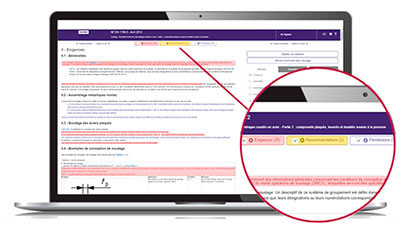
ZOOM ON ... the Requirements department

To comply with a standard, you need to quickly understand its issues in order to determine its impact on your activity.

The Requirements department helps you quickly locate within the normative text:

  • mandatory clauses to satisfy,
  • non-essential but useful clauses to know, such as permissions and recommendations.

The identification of these types of clauses is based on the document "ISO/IEC Directives, Part 2 - Principles and rules of structure and drafting of ISO documents" as well as on a constantly enriched list of verbal forms.

With Requirements, quickly access the main part of the normative text!


What is the Redline format?
Need to identify, monitor and decipher standards?