ISO 11666:2018
ISO 11666:2018

ISO 11666:2018

January 2018
International standard Current

Non-destructive testing of welds - Ultrasonic testing - Acceptance levels

ISO 11666:2018 specifies two ultrasonic acceptance levels known as acceptance level 2 (AL 2) and acceptance level 3 (AL 3) for full penetration welded joints in ferritic steels, which correspond to ISO 5817:2014, quality levels B and C. An acceptance level corresponding to ISO 5817:2014, quality level D is not included in this document, as ultrasonic testing is generally not requested for this weld quality.These acceptance levels are applicable to testing carried out in accordance with ISO 17640.ISO 11666:2018 applies to the testing of full penetration ferritic steel welds, with thicknesses from 8 mm to 100 mm. It can also be used for other types of welds, materials and thicknesses, provided the tests have been performed with necessary consideration of the geometry and acoustic properties of the component, and an adequate sensitivity can be employed to enable the acceptance levels of this document to be applied. The nominal frequency of probes used in this document is between 2 MHz and 5 MHz, unless attenuation or requirements for higher resolution call for other frequencies. It is important to consider the use of these acceptance levels in conjunction with frequencies outside this range carefully.


View the extract
Main informations

Collections

International ISO standards

Publication date

January 2018

Number of pages

17 p.

Reference

ISO 11666:2018

ICS Codes

25.160.40   Welded joints and welds

Print number

1
Sumary
Non-destructive testing of welds - Ultrasonic testing - Acceptance levels

ISO 11666:2018 specifies two ultrasonic acceptance levels known as acceptance level 2 (AL 2) and acceptance level 3 (AL 3) for full penetration welded joints in ferritic steels, which correspond to ISO 5817:2014, quality levels B and C. An acceptance level corresponding to ISO 5817:2014, quality level D is not included in this document, as ultrasonic testing is generally not requested for this weld quality.

These acceptance levels are applicable to testing carried out in accordance with ISO 17640.

ISO 11666:2018 applies to the testing of full penetration ferritic steel welds, with thicknesses from 8 mm to 100 mm. It can also be used for other types of welds, materials and thicknesses, provided the tests have been performed with necessary consideration of the geometry and acoustic properties of the component, and an adequate sensitivity can be employed to enable the acceptance levels of this document to be applied. The nominal frequency of probes used in this document is between 2 MHz and 5 MHz, unless attenuation or requirements for higher resolution call for other frequencies. It is important to consider the use of these acceptance levels in conjunction with frequencies outside this range carefully.
Replaced standards (1)
ISO 11666:2010
ISO 11666:2010
December 2010
International standard Cancelled
Non-destructive testing of welds - Ultrasonic testing - Acceptance levels

ISO 11666:2010 specifies ultrasonic acceptance levels 2 and 3 for full penetration welded joints in ferritic steels, which correspond to ISO 5817 quality levels B and C. An acceptance level corresponding to ISO 5817 quality level D is not included in ISO 11666:2010 as ultrasonic testing is generally not requested for this weld quality. These acceptance levels are applicable to testing carried out in accordance with ISO 17640. ISO 11666:2010 applies to the examination of full penetration ferritic steel welds, with thicknesses from 8 mm to 100 mm. It can also be used for other types of welds, materials and thicknesses above 100 mm, provided the examinations have been performed with necessary consideration of the geometry and acoustic properties of the component, and an adequate sensitivity can be employed to enable the acceptance levels of ISO 11666:2010 to be applied. The nominal frequency of probes used in ISO 11666:2010 is between 2 MHz and 5 MHz unless attenuation or requirements for higher resolution call for other frequencies. The use of these acceptance levels in conjunction with frequencies outside this range needs to be considered carefully.

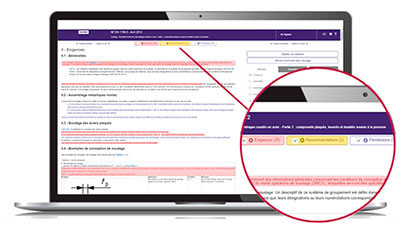
ZOOM ON ... the Requirements department

To comply with a standard, you need to quickly understand its issues in order to determine its impact on your activity.

The Requirements department helps you quickly locate within the normative text:

  • mandatory clauses to satisfy,
  • non-essential but useful clauses to know, such as permissions and recommendations.

The identification of these types of clauses is based on the document "ISO/IEC Directives, Part 2 - Principles and rules of structure and drafting of ISO documents" as well as on a constantly enriched list of verbal forms.

With Requirements, quickly access the main part of the normative text!


What is the Redline format?
Need to identify, monitor and decipher standards?