ISO 12922:2020
ISO 12922:2020

ISO 12922:2020

February 2020
International standard Current

Lubricants, industrial oils and related products (class L) — Family H (hydraulic systems) — Specifications for hydraulic fluids in categories HFAE, HFAS, HFB, HFC, HFDR and HFDU

This document specifies the minimum requirements of unused fire-resistant and less flammable hydraulic fluids for hydrostatic and hydrodynamic systems in general industrial applications. It is not intended for use in aerospace or power-generation applications, where different requirements apply. It provides guidance for suppliers and end users of these less hazardous fluids and to the manufacturers of hydraulic equipment in which they are used.Of the categories covered by ISO 6743-4, which classifies the different types of fluids used in hydraulic applications, only the following are detailed in this document: HFAE, HFAS, HFB, HFC, HFDR and HFDU.Types HFAE, HFAS, HFB, HFC and HFDR are "fire-resistant" fluids as defined by ISO 5598. Most HFDU fluids, while displaying an improvement in combustion behaviour over mineral oil, fall outside this definition and are more appropriately considered as "less flammable" fluids.


View the extract
Main informations

Collections

International ISO standards

Publication date

February 2020

Number of pages

12 p.

Reference

ISO 12922:2020

ICS Codes

75.120   Hydraulic fluids

Print number

3
Sumary
Lubricants, industrial oils and related products (class L) — Family H (hydraulic systems) — Specifications for hydraulic fluids in categories HFAE, HFAS, HFB, HFC, HFDR and HFDU

This document specifies the minimum requirements of unused fire-resistant and less flammable hydraulic fluids for hydrostatic and hydrodynamic systems in general industrial applications. It is not intended for use in aerospace or power-generation applications, where different requirements apply. It provides guidance for suppliers and end users of these less hazardous fluids and to the manufacturers of hydraulic equipment in which they are used.

Of the categories covered by ISO 6743-4, which classifies the different types of fluids used in hydraulic applications, only the following are detailed in this document: HFAE, HFAS, HFB, HFC, HFDR and HFDU.

Types HFAE, HFAS, HFB, HFC and HFDR are "fire-resistant" fluids as defined by ISO 5598. Most HFDU fluids, while displaying an improvement in combustion behaviour over mineral oil, fall outside this definition and are more appropriately considered as "less flammable" fluids.
Replaced standards (1)
ISO 12922:2012
ISO 12922:2012
December 2012
International standard Cancelled
Lubricants, industrial oils and related products (class L) - Family H (Hydraulic systems) - Specifications for categories HFAE, HFAS, HFB, HFC, HFDR and HFDU

ISO 12922:2012 specifies the minimum requirements of unused fire-resistant and less-flammable hydraulic fluids for hydrostatic and hydrodynamic systems in general industrial applications. It is not intended for use in aerospace or power-generation applications, where different requirements apply. It provides guidance for suppliers and end users of these less hazardous fluids and to the manufacturers of hydraulic equipment in which they are used. Of the categories covered by ISO 6743-4, which classifies the different types of fluids used in hydraulic applications, only the following are detailed in this International Standard: HFAE, HFAS, HFB, HFC, HFDR and HFDU.

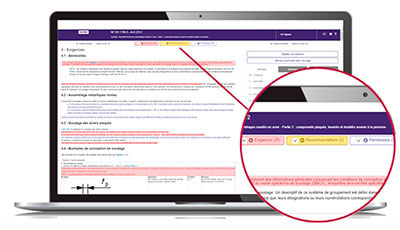
ZOOM ON ... the Requirements department

To comply with a standard, you need to quickly understand its issues in order to determine its impact on your activity.

The Requirements department helps you quickly locate within the normative text:

  • mandatory clauses to satisfy,
  • non-essential but useful clauses to know, such as permissions and recommendations.

The identification of these types of clauses is based on the document "ISO/IEC Directives, Part 2 - Principles and rules of structure and drafting of ISO documents" as well as on a constantly enriched list of verbal forms.

With Requirements, quickly access the main part of the normative text!


Need to identify, monitor and decipher standards?