ISO 13196:2026
Soil quality — Screening soils for selected elements by energy-dispersive X-ray fluorescence spectrometry using a handheld or portable instrument
This document specifies the procedure for screening soils for selected elements using handheld or portable equipment for energy dispersive X-ray fluorescence spectrometry (ED-XRF). It covers the application of this screening method to obtain qualitative or semi-quantitative data to assist decisions on a sampling strategy for detailed assessment of soil quality employing laboratory analytical chemical methods.NOTE 1 Screening methods generally provide qualitative or semi-quantitative concentration values that are indicative of concentration values, although occasionally they can give quantitative results under specific or limited conditions.NOTE 2 The greater the effort applied to the pretreatment of soil samples, the better the analytical results that can be expected (see e.g. Reference [19]).This document does not explicitly specify elements for which it is applicable, since the applicability depends on the performance of the apparatus and the objective of the screening. The elements which can be determined are limited by the performance of the instrument used, the concentrations of particular elements present in the soil, and the requirements of the investigation in terms of the minimum concentrations of concern (e.g. guideline value).NOTE 3 The XRF measurements of As, Cd, Co, Cr, Cu, Hg, Mo, Ni, Pb, Sb, Sn, V and Zn were validated as described in Annex A.NOTE 4 Annex B provides examples of when screening with a handheld ED-XRF spectrometer and a portable ED-XRF spectrometer can be useful.This document does not provide guidance on how to use the equipment to provide quantitative data for use in detailed site assessments. This document does not cover how the results of multiple determinations are synthesized to address the objectives of an ED-XRF determination.

This document specifies the procedure for screening soils for selected elements using handheld or portable equipment for energy dispersive X-ray fluorescence spectrometry (ED-XRF). It covers the application of this screening method to obtain qualitative or semi-quantitative data to assist decisions on a sampling strategy for detailed assessment of soil quality employing laboratory analytical chemical methods.
NOTE 1 Screening methods generally provide qualitative or semi-quantitative concentration values that are indicative of concentration values, although occasionally they can give quantitative results under specific or limited conditions.
NOTE 2 The greater the effort applied to the pretreatment of soil samples, the better the analytical results that can be expected (see e.g. Reference [19]).
This document does not explicitly specify elements for which it is applicable, since the applicability depends on the performance of the apparatus and the objective of the screening. The elements which can be determined are limited by the performance of the instrument used, the concentrations of particular elements present in the soil, and the requirements of the investigation in terms of the minimum concentrations of concern (e.g. guideline value).
NOTE 3 The XRF measurements of As, Cd, Co, Cr, Cu, Hg, Mo, Ni, Pb, Sb, Sn, V and Zn were validated as described in Annex A.
NOTE 4 Annex B provides examples of when screening with a handheld ED-XRF spectrometer and a portable ED-XRF spectrometer can be useful.
This document does not provide guidance on how to use the equipment to provide quantitative data for use in detailed site assessments. This document does not cover how the results of multiple determinations are synthesized to address the objectives of an ED-XRF determination.
ISO 13196:2013 specifies the procedure for screening soils and soil-like materials for selected elements when handheld or portable energy-dispersive XRF spectrometers are used. This quick method is assumed to be applied on-site to obtain qualitative or semiquantitative data that assists decisions on further sampling strategy for assessing soil quality. The higher the efforts for pretreatment used on soil samples, the better the analytical results can be expected. ISO 13196:2013 does not explicitly specify elements for which it is applicable, since the applicability depends on the performance of the apparatus and the objective of the screening. The elements which can be determined are limited by the performance of the instruments used, the concentration of the element present in the soil, and the requirements of the investigation (e.g. guideline value). For Hg, Cd, Co, Mo, V and Sb, a majority of instruments are not sensitive enough to reach sufficiently low limits of quantification (LOQ) to meet the requirements (limit or threshold values) set in the ordinances of different countries. In this case, other methods need to be employed to measure these low concentrations. Usually, wet chemical methods are used, based on aqua regia extracts, in combination with optical or mass spectrometric (MS) methods like atomic absorption spectrometry (AAS), inductively coupled plasma/optical emission spectrometry (ICP/OES) or ICP/MS.
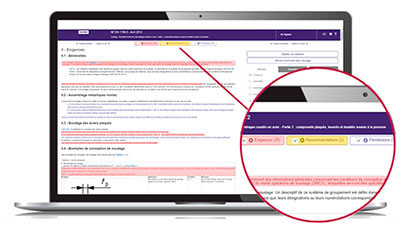
The Requirements department helps you quickly locate within the normative text:
- mandatory clauses to satisfy,
- non-essential but useful clauses to know, such as permissions and recommendations.
The identification of these types of clauses is based on the document “ISO / IEC Directives, Part 2 - Principles and rules of structure and drafting of ISO documents ”as well as on a constantly enriched list of verbal forms.
With Requirements, quickly access the main part of the normative text!

COBAZ is the simple and effective solution to meet the normative needs related to your activity, in France and abroad.
Available by subscription, CObaz is THE modular solution to compose according to your needs today and tomorrow. Quickly discover CObaz!
Request your free, no-obligation live demo
I discover COBAZ