ISO 13347-2:2025
Fans - Determination of fan sound power levels under standardized laboratory conditions - Part 2: Reverberant room method
This document specifies determining sound power levels of fans under standardized laboratory conditions from sound pressure levels measured in a reverberant room.This document is applicable for determination of the acoustic performance of fans. This document can additionally be applied to determine the acoustic performance of fans combined with an ancillary device, such as a roof cowl or damper or, where the fan is fitted with a silencer, the sound power resulting from the fan and silencer combination. For guidance of testing with ancillary items, see Annex C.This document applies to fans as defined in ISO 13349-1. It is limited to the determination of airborne sound emission for the specified set-ups. Vibration is not measured, nor is the sensitivity of airborne sound emission to vibration effects determined.This document is intended to be used in conjunction with ISO 5136, which covers the in-duct method, and ISO 10302-1 for small fans.The size of fans which can be tested in accordance with this document is limited only by the practical aspects of the test set-up. Test fan dimensions and air performance will control the room size. NOTE Based on usage, small fans can be tested according to this document or to ISO 10302-1.For reverberant field tests, the size of equipment under test is limited to less than 2 % of the room volume.For low power fans (up to 3 kW) that can be run from a domestic power supply (single phase AC at a voltage not exceeding 250 V and a current not exceeding 16 A), reference IEC 60704-2-7[18].The test arrangements in this document establish the laboratory conditions necessary for a successful test. It is difficult to meet these requirements in situ and this document is not intended for field measurements. In these situations, users are reminded that the acoustic environment is unlikely to meet the specified conditions and there can be additional acoustic system effects where inlet and outlet conditions at the fan are less than ideal.
This document specifies determining sound power levels of fans under standardized laboratory conditions from sound pressure levels measured in a reverberant room.
This document is applicable for determination of the acoustic performance of fans. This document can additionally be applied to determine the acoustic performance of fans combined with an ancillary device, such as a roof cowl or damper or, where the fan is fitted with a silencer, the sound power resulting from the fan and silencer combination. For guidance of testing with ancillary items, see Annex C.
This document applies to fans as defined in ISO 13349-1. It is limited to the determination of airborne sound emission for the specified set-ups. Vibration is not measured, nor is the sensitivity of airborne sound emission to vibration effects determined.
This document is intended to be used in conjunction with ISO 5136, which covers the in-duct method, and ISO 10302-1 for small fans.
The size of fans which can be tested in accordance with this document is limited only by the practical aspects of the test set-up. Test fan dimensions and air performance will control the room size.
NOTE Based on usage, small fans can be tested according to this document or to ISO 10302-1.
For reverberant field tests, the size of equipment under test is limited to less than 2 % of the room volume.
For low power fans (up to 3 kW) that can be run from a domestic power supply (single phase AC at a voltage not exceeding 250 V and a current not exceeding 16 A), reference IEC 60704-2-7[18].
The test arrangements in this document establish the laboratory conditions necessary for a successful test. It is difficult to meet these requirements in situ and this document is not intended for field measurements. In these situations, users are reminded that the acoustic environment is unlikely to meet the specified conditions and there can be additional acoustic system effects where inlet and outlet conditions at the fan are less than ideal.
ISO 13347-2:2004 gives a detailed description of reverberant room methods for the determination of fan sound power levels. It is for use under standardized laboratory conditions and recognises that tests in situ are subject to increased uncertainty. These test procedures are not necessarily appropriate to site test conditions. Acoustic system effects are presently the subject of considerable research effort. ISO 5136, which covers the in-duct method, and ISO 10302 for small fans, should be used in conjunction with ISO 13347-2:2004.
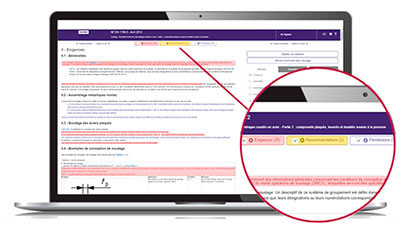
The Requirements department helps you quickly locate within the normative text:
- mandatory clauses to satisfy,
- non-essential but useful clauses to know, such as permissions and recommendations.
The identification of these types of clauses is based on the document “ISO / IEC Directives, Part 2 - Principles and rules of structure and drafting of ISO documents ”as well as on a constantly enriched list of verbal forms.
With Requirements, quickly access the main part of the normative text!

COBAZ is the simple and effective solution to meet the normative needs related to your activity, in France and abroad.
Available by subscription, CObaz is THE modular solution to compose according to your needs today and tomorrow. Quickly discover CObaz!
Request your free, no-obligation live demo
I discover COBAZ