
ISO 13715:2017
ISO 13715:2017

ISO 13715:2017

March 2017
International standard Current

Technical product documentation - Edges of undefined shape - Indication and dimensioning

ISO 13715:2017 specifies rules for the indication and dimensioning of undefined edges in technical product and dimensions. The proportions and dimensions of the graphical symbols to be used are also specified.In cases where the geometrically defined shape of an edge (for example, 1 × 45°) is required, the general dimensioning principles given in ISO 129‑1 apply.

View the extract
Main informations

Collections

International ISO standards

Publication date

March 2017

Number of pages

22 p.

Reference

ISO 13715:2017

ICS Codes

01.040.01   Generalities. Terminology. Standardization. Documentation (Vocabularies)
01.100.20   Mechanical engineering drawings

Print number

1
Sumary
Technical product documentation - Edges of undefined shape - Indication and dimensioning

ISO 13715:2017 specifies rules for the indication and dimensioning of undefined edges in technical product and dimensions. The proportions and dimensions of the graphical symbols to be used are also specified.

In cases where the geometrically defined shape of an edge (for example, 1 × 45°) is required, the general dimensioning principles given in ISO 129‑1 apply.

Replaced standards (1)
ISO 13715:2000
ISO 13715:2000
June 2000
International standard Cancelled
Technical drawings - Edges of undefined shape - Vocabulary and indications

La présente Norme internationale définit les termes décrivant les états d'arêtes et spécifie les règles concernant les indications à faire figurer sur les dessins techniques pour représenter les états d'arêtes aux formes non définies. Elle spécifie également les proportions et dimensions des symboles graphiques utilisés pour cette indication. Dans le cas où une forme d'arête définie dans sa géométrie est requise, par exemple 1 x 45°, les principes généraux de cotation établis dans l'ISO 129-1 s'appliquent.

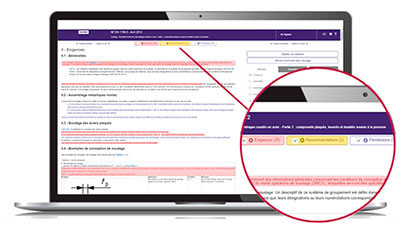
ZOOM ON ... the Requirements department

To comply with a standard, you need to quickly understand its issues in order to determine its impact on your activity.

The Requirements department helps you quickly locate within the normative text:

  • mandatory clauses to satisfy,
  • non-essential but useful clauses to know, such as permissions and recommendations.

The identification of these types of clauses is based on the document "ISO/IEC Directives, Part 2 - Principles and rules of structure and drafting of ISO documents" as well as on a constantly enriched list of verbal forms.

With Requirements, quickly access the main part of the normative text!


What is the Redline format?
Need to identify, monitor and decipher standards?