ISO 15004-2:2024

ISO 15004-2:2024

December 2024
International standard Current

Ophthalmic instruments - Fundamental requirements and test methods - Part 2: Light hazard protection

This document specifies fundamental requirements for optical radiation safety for ophthalmic instruments and is applicable to all ophthalmic instruments that direct optical radiation into or at the eye. It is also applicable to all new and emerging ophthalmic instruments that direct optical radiation into or at the eye, as well as to those portions of therapeutic or surgical systems that direct optical radiation into or at the eye for diagnostic, illumination, measurement, imaging or alignment purposes.NOTE            For the purpose of this document, optical radiation relates to the wavelength range of 250 nm to 2 500 nm.This document does not apply to therapeutic radiation. However, in the case of the treatment beams of therapeutic devices, when conducting risk assessments for non-target tissues, the limits given in this document may be applied to those parts of the treatment beam that strike non-target tissue.Where vertical (instrument-specific) International Standards contain specific light hazard requirements different from those given in ISO 15004-2, then those in the vertical International Standard take precedence.This document classifies ophthalmic instruments into either Group 1 or Group 2 to distinguish instruments that are non-hazardous from those that are potentially hazardous.
View the extract
Main informations

Collections

International ISO standards

Publication date

December 2024

Number of pages

56 p.

Reference

ISO 15004-2:2024

ICS Codes

11.040.70   Ophthalmic equipment

Print number

1
Sumary
Ophthalmic instruments - Fundamental requirements and test methods - Part 2: Light hazard protection

This document specifies fundamental requirements for optical radiation safety for ophthalmic instruments and is applicable to all ophthalmic instruments that direct optical radiation into or at the eye. It is also applicable to all new and emerging ophthalmic instruments that direct optical radiation into or at the eye, as well as to those portions of therapeutic or surgical systems that direct optical radiation into or at the eye for diagnostic, illumination, measurement, imaging or alignment purposes.

NOTE            For the purpose of this document, optical radiation relates to the wavelength range of 250 nm to 2 500 nm.

This document does not apply to therapeutic radiation. However, in the case of the treatment beams of therapeutic devices, when conducting risk assessments for non-target tissues, the limits given in this document may be applied to those parts of the treatment beam that strike non-target tissue.

Where vertical (instrument-specific) International Standards contain specific light hazard requirements different from those given in ISO 15004-2, then those in the vertical International Standard take precedence.

This document classifies ophthalmic instruments into either Group 1 or Group 2 to distinguish instruments that are non-hazardous from those that are potentially hazardous.

Replaced standards (1)
ISO 15004-2:2007
February 2007
International standard Cancelled
Ophthalmic instruments - Fundamental requirements and test methods - Part 2 : light hazard protection

ISO 15004-2:2007 specifies fundamental requirements for optical radiation safety for ophthalmic instruments and is applicable to all ophthalmic instruments that direct optical radiation into or at the eye and for which there is a specific light hazards requirement section within their respective International Standards. It is also applicable to all new and emerging ophthalmic instruments that direct optical radiation into or at the eye. ISO 15004-2:2007 does not apply to radiation that is in excess of limits specified in ISO 15004 and that is intended for treatment of the eye. ISO 15004-2:2007 classifies ophthalmic instruments into either Group 1 or a Group 2 in order to distinguish instruments that are non-hazardous from those that are potentially hazardous.

ZOOM ON ... the Requirements department
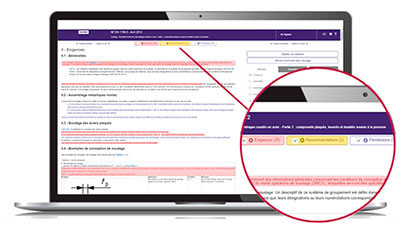
To comply with a standard, you need to quickly understand its issues in order to determine its impact on your activity.

The Requirements department helps you quickly locate within the normative text:
- mandatory clauses to satisfy,
- non-essential but useful clauses to know, such as permissions and recommendations.

The identification of these types of clauses is based on the document “ISO / IEC Directives, Part 2 - Principles and rules of structure and drafting of ISO documents ”as well as on a constantly enriched list of verbal forms.

With Requirements, quickly access the main part of the normative text!

With Requirements, quickly access the main part of the normative text!
What is the Redline format?
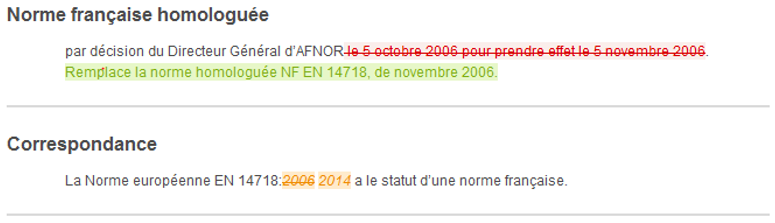
The Redline + service - standards comparator allows you to easily and simply identify major changes between the current standard and its last canceled version.

At a glance, you will be able to identify the additions, deletions or modifications to a text, table, figure and formula.
At a glance, you will be able to identify the additions, deletions or modifications to a text, table, figure and formula

The Redlines + service is offered to you on the collection of French standards in force, in French language and in HTML and PDF format.

For an overview of the service, click on View a standard in redline format
Need to identify, monitor and decipher standards?

COBAZ is the simple and effective solution to meet the normative needs related to your activity, in France and abroad.

Available by subscription, CObaz is THE modular solution to compose according to your needs today and tomorrow. Quickly discover CObaz!

Request your free, no-obligation live demo

I discover COBAZ