ISO 15031-6:2015
ISO 15031-6:2015

ISO 15031-6:2015

July 2015
International standard Current

Road vehicles — Communication between vehicle and external equipment for emissions-related diagnostics — Part 6: Diagnostic trouble code definitions

ISO 15031-6:2015 provides uniformity for standardized diagnostic trouble codes (DTC) that electrical/electronic On-Board Diagnostic (OBD) systems of motor vehicles are required to report when malfunctions are detected. It further provides guidance for uniform messages (text descriptor) associated with these codes.ISO 15031-6:2015 specifies the rules and guidelines for the definition of the following: a) the diagnostic trouble code format, which consists of addressing format, structure and messages; b) a description of the standardized set of diagnostic trouble codes and descriptions contained in SAE J2012-DA. The two most significant bytes of a DTC may be decoded according to two different lists in two formats: DTC Format Identifier 0016 and 0416; and c) a description of the standardized set of diagnostic trouble codes subtypes known as failure types contained in SAE J2012-DA (applies only when 3-byte DTCs are used).ISO 15031-6:2015 specifies all general rules and guidelines to define new diagnostic trouble codes. It references SAE J2012-DA (Digital Annex), which includes all standardized DTCs (number and text descriptor) as well as all diagnostic trouble codes subtypes known as failure types.


View the extract
Main informations

Collections

International ISO standards

Publication date

July 2015

Number of pages

16 p.

Reference

ISO 15031-6:2015

ICS Codes

13.040.50   Transport exhaust emissions
43.040.10   Electrical and electronic equipment

Print number

3
Sumary
Road vehicles — Communication between vehicle and external equipment for emissions-related diagnostics — Part 6: Diagnostic trouble code definitions

ISO 15031-6:2015 provides uniformity for standardized diagnostic trouble codes (DTC) that electrical/electronic On-Board Diagnostic (OBD) systems of motor vehicles are required to report when malfunctions are detected. It further provides guidance for uniform messages (text descriptor) associated with these codes.

ISO 15031-6:2015 specifies the rules and guidelines for the definition of the following: a) the diagnostic trouble code format, which consists of addressing format, structure and messages; b) a description of the standardized set of diagnostic trouble codes and descriptions contained in SAE J2012-DA. The two most significant bytes of a DTC may be decoded according to two different lists in two formats: DTC Format Identifier 0016 and 0416; and c) a description of the standardized set of diagnostic trouble codes subtypes known as failure types contained in SAE J2012-DA (applies only when 3-byte DTCs are used).

ISO 15031-6:2015 specifies all general rules and guidelines to define new diagnostic trouble codes. It references SAE J2012-DA (Digital Annex), which includes all standardized DTCs (number and text descriptor) as well as all diagnostic trouble codes subtypes known as failure types.
Replaced standards (1)
ISO 15031-6:2010
ISO 15031-6:2010
August 2010
International standard Cancelled
Road vehicles - Communication between vehicle and external equipment for emissions-related diagnostics - Part 6 : diagnostic trouble code definitions

ISO 15031-6:2010 provides uniformity for standardized Diagnostic Trouble Codes (DTC) that electrical/electronic On-Board Diagnostic (OBD) systems of motor vehicles are required to report when malfunctions are detected. It also provides guidance for uniform messages (text descriptor) associated with these codes. ISO 15031-6 specifies the rules and guidelines for the definition of the DTC format, which consists of an addressing format, structure, and messages; a standardized set of DTCs and descriptions; and a standardized set of DTC subtypes known as Failure Types. ISO 15031-6:2010 specifies all general rules and guidelines to define new DTCs. It references the SAE J2012-DA (Digital Annex), which includes all standardized DTCs (number and text descriptor) as well as all DTC subtypes known as failure types.

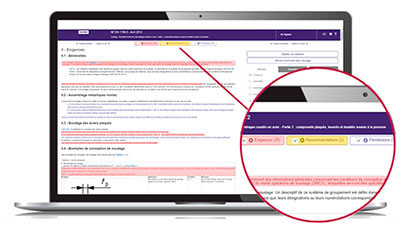
ZOOM ON ... the Requirements department

To comply with a standard, you need to quickly understand its issues in order to determine its impact on your activity.

The Requirements department helps you quickly locate within the normative text:

  • mandatory clauses to satisfy,
  • non-essential but useful clauses to know, such as permissions and recommendations.

The identification of these types of clauses is based on the document "ISO/IEC Directives, Part 2 - Principles and rules of structure and drafting of ISO documents" as well as on a constantly enriched list of verbal forms.

With Requirements, quickly access the main part of the normative text!

With Requirements, quickly access the main part of the normative text!
Need to identify, monitor and decipher standards?