ISO 16000-23:2018
Indoor air - Part 23: Performance test for evaluating the reduction of formaldehyde and other carbonyl compounds concentrations by sorptive building materials
This document specifies a general laboratory test method for evaluating the reduction of formaldehyde and other carbonyl compounds (aldehydes and ketones) concentrations by sorptive building materials. This method applies to boards, wallpapers, carpets, paint products, and other building materials. The sorption of those target compounds, i.e. formaldehyde and other carbonyl compounds, can be brought about by adsorption, absorption and chemisorption.The method specified in this document employs formaldehyde and other carbonyl compound spiked supply air to determine the performance of building materials in reducing formaldehyde and other carbonyl compounds concentrations.This document is based on the test chamber method specified in ISO 16000-9. Sampling, transport and storage of materials to be tested and preparation of test specimens are specified in ISO 16000-11. Air sampling and analytical methods for the determination of formaldehyde and other carbonyl compounds are specified in ISO 16000-3, which is part of the complete procedure.This document applies to the determination of formaldehyde and other carbonyl compounds, such as formaldehyde, acetaldehyde, acetone, benzaldehyde, butyraldehyde, valeraldehyde, 2,5-dimethylbenzaldehyde, capronaldehyde, isovaleraldehyde, propionaldehyde, o-tolualdehyde, m-tolualdehyde, p-tolualdehyde.
This document specifies a general laboratory test method for evaluating the reduction of formaldehyde and other carbonyl compounds (aldehydes and ketones) concentrations by sorptive building materials. This method applies to boards, wallpapers, carpets, paint products, and other building materials. The sorption of those target compounds, i.e. formaldehyde and other carbonyl compounds, can be brought about by adsorption, absorption and chemisorption.
The method specified in this document employs formaldehyde and other carbonyl compound spiked supply air to determine the performance of building materials in reducing formaldehyde and other carbonyl compounds concentrations.
This document is based on the test chamber method specified in ISO 16000-9. Sampling, transport and storage of materials to be tested and preparation of test specimens are specified in ISO 16000-11. Air sampling and analytical methods for the determination of formaldehyde and other carbonyl compounds are specified in ISO 16000-3, which is part of the complete procedure.
This document applies to the determination of formaldehyde and other carbonyl compounds, such as formaldehyde, acetaldehyde, acetone, benzaldehyde, butyraldehyde, valeraldehyde, 2,5-dimethylbenzaldehyde, capronaldehyde, isovaleraldehyde, propionaldehyde, o-tolualdehyde, m-tolualdehyde, p-tolualdehyde.
ISO 16000-23:2009 specifies a general laboratory test method for evaluating the reduction of formaldehyde concentrations by sorptive building materials. This method applies to boards, wallpapers, carpets, paint products, and other building materials. The sorption of formaldehyde can be brought about by adsorption, absorption and chemisorption. The performance of the material with respect to its ability to reduce the concentration of formaldehyde in indoor air is evaluated by measuring sorption flux and saturation mass per area. The former directly indicates material performance with respect to formaldehyde concentration reduction at a point in time; the latter relates to the ability of a product to maintain that performance. The method specified in ISO 16000-23:2009 employs formaldehyde-spiked supply air to determine the performance of building materials in reducing formaldehyde concentrations. The characteristics of formaldehyde sorption depend greatly on humidity. Formaldehyde is less stable in air than other volatile organic compounds, so it has to be tested on its own. ISO 16000-23:2009 is based on the test chamber method specified in ISO 16000-9. Sampling, transport and storage of materials to be tested, and preparation of test specimens are specified in ISO 16000-11. Air sampling and analytical methods for the determination of formaldehyde are specified in ISO 16000-3, which is part of the complete procedure.
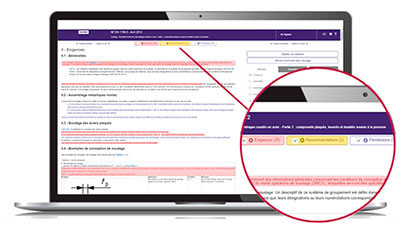
The Requirements department helps you quickly locate within the normative text:
- mandatory clauses to satisfy,
- non-essential but useful clauses to know, such as permissions and recommendations.
The identification of these types of clauses is based on the document “ISO / IEC Directives, Part 2 - Principles and rules of structure and drafting of ISO documents ”as well as on a constantly enriched list of verbal forms.
With Requirements, quickly access the main part of the normative text!

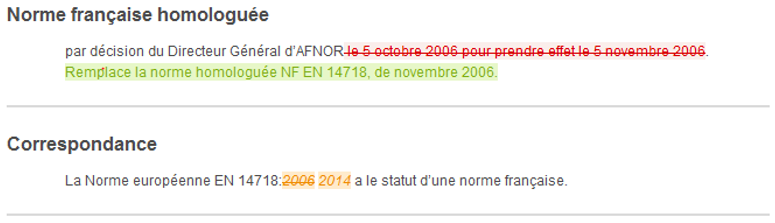
At a glance, you will be able to identify the additions, deletions or modifications to a text, table, figure and formula.

The Redlines + service is offered to you on the collection of French standards in force, in French language and in HTML and PDF format.
For an overview of the service, click on View a standard in redline format
COBAZ is the simple and effective solution to meet the normative needs related to your activity, in France and abroad.
Available by subscription, CObaz is THE modular solution to compose according to your needs today and tomorrow. Quickly discover CObaz!
Request your free, no-obligation live demo
I discover COBAZ