

ISO 16100-2:2003
ISO 16100-2:2003

ISO 16100-2:2003

November 2003
International standard Current

Industrial automation systems and integration - Manufacturing software capability profiling for interoperability - Part 2 : profiling methodology

ISO 16100-2:2003 specifies a methodology for constructing profiles of manufacturing software capabilities, and is applicable to software products used in the manufacturing domain. It is an integral part of ISO 16100 (all parts), a series of International Standards for the computer-interpretable and human readable representation of a software capability profile. The goal of ISO 16100 (all parts) is to provide a method to represent the capability of manufacturing software relative to its role throughout the life cycle of a manufacturing application, independent of a particular system architecture or implementation platform.

View the extract
Main informations

Collections

International ISO standards

Publication date

November 2003

Number of pages

17 p.

Reference

ISO 16100-2:2003

ICS Codes

25.040.01   Industrial automation systems in general

Print number

1 - novembre 2003
Sumary
Industrial automation systems and integration - Manufacturing software capability profiling for interoperability - Part 2 : profiling methodology

ISO 16100-2:2003 specifies a methodology for constructing profiles of manufacturing software capabilities, and is applicable to software products used in the manufacturing domain. It is an integral part of ISO 16100 (all parts), a series of International Standards for the computer-interpretable and human readable representation of a software capability profile. The goal of ISO 16100 (all parts) is to provide a method to represent the capability of manufacturing software relative to its role throughout the life cycle of a manufacturing application, independent of a particular system architecture or implementation platform.

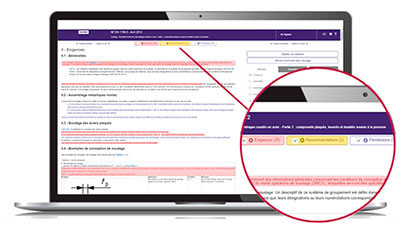
ZOOM ON ... the Requirements department

To comply with a standard, you need to quickly understand its issues in order to determine its impact on your activity.

The Requirements department helps you quickly locate within the normative text:

  • mandatory clauses to satisfy,
  • non-essential but useful clauses to know, such as permissions and recommendations.

The identification of these types of clauses is based on the document "ISO/IEC Directives, Part 2 - Principles and rules of structure and drafting of ISO documents" as well as on a constantly enriched list of verbal forms.

With Requirements, quickly access the main part of the normative text!


Need to identify, monitor and decipher standards?