ISO 17575-1:2016

ISO 17575-1:2016

January 2016
International standard Current

Electronic fee collection — Application interface definition for autonomous systems — Part 1: Charging

ISO 17575-1:2016 defines the format and semantics of the data exchange between a Front End (OBE plus optional proxy) and corresponding Back Ends in autonomous toll schemes. It defines the data elements that are used to generate charge reports containing information about the road usage of a vehicle for certain time intervals, sent from the Front End to the Back End. It also defines the data that can be used to re-configure the ongoing process of gathering charge relevant information in the Front End. The scope is shown in Figure 1.The constitution of the charge report is dependent on configuration data that are assumed to be present in the Front End. The assembly of charge reports can be configured for each individual toll scheme according to local needs. Charge reports generated in accordance with this part of ISO 17575 are consistent with the requirements derived from the architectural concept defined in ISO 17573:2010.The definitions in ISO 17575-1:2016 comprise- reporting data, i.e. data for transferring road usage data from Front End to Back End, including a response from the Back End towards the Front End,- data for supporting security mechanisms,- contract data, i.e. data for identifying contractually essential entities,- road usage data, i.e. data for reporting the amount of road usage,- account data for managing a payment account,- versioning data, and- compliance checking data, i.e. data imported from ISO 12813:2015, which are required in compliance checking communication.Annex A contains the data type specifications using ASN.1 notation.The protocol implementation conformity statements (PICS) proforma are provided in Annex B.Annex C provides a graphical presentation of the structure of the data elements described in Clause 7.Annex D provides information on how this part of ISO 17575 can be used in EETS environment and how the requirements that are specified in the EU-Decision 2009/750 are addressed by this standard.
View the extract
Main informations

Collections

International ISO standards

Thematics

Management et performance

Publication date

January 2016

Number of pages

41 p.

Reference

ISO 17575-1:2016

ICS Codes

03.220.20   Road transport
35.240.60   IT applications in transport

Print number

1
Sumary
Electronic fee collection — Application interface definition for autonomous systems — Part 1: Charging

ISO 17575-1:2016 defines the format and semantics of the data exchange between a Front End (OBE plus optional proxy) and corresponding Back Ends in autonomous toll schemes. It defines the data elements that are used to generate charge reports containing information about the road usage of a vehicle for certain time intervals, sent from the Front End to the Back End. It also defines the data that can be used to re-configure the ongoing process of gathering charge relevant information in the Front End. The scope is shown in Figure 1.

The constitution of the charge report is dependent on configuration data that are assumed to be present in the Front End. The assembly of charge reports can be configured for each individual toll scheme according to local needs. Charge reports generated in accordance with this part of ISO 17575 are consistent with the requirements derived from the architectural concept defined in ISO 17573:2010.

The definitions in ISO 17575-1:2016 comprise

- reporting data, i.e. data for transferring road usage data from Front End to Back End, including a response from the Back End towards the Front End,

- data for supporting security mechanisms,

- contract data, i.e. data for identifying contractually essential entities,

- road usage data, i.e. data for reporting the amount of road usage,

- account data for managing a payment account,

- versioning data, and

- compliance checking data, i.e. data imported from ISO 12813:2015, which are required in compliance checking communication.

Annex A contains the data type specifications using ASN.1 notation.

The protocol implementation conformity statements (PICS) proforma are provided in Annex B.

Annex C provides a graphical presentation of the structure of the data elements described in Clause 7.

Annex D provides information on how this part of ISO 17575 can be used in EETS environment and how the requirements that are specified in the EU-Decision 2009/750 are addressed by this standard.

Replaced standards (2)
Technical specification Cancelled
Technical coorigendum 1 to standard ISO/TS 17575-1:2010

Technical specification Cancelled
Electronic fee collection - Application interface definition for autonomous systems - Part 1 : charging

ISO/TS 17575‑1:2010 defines the format and semantic of the data exchange between a Front End (OBE plus optional proxy) and corresponding Back Ends in autonomous toll regimes. ISO/TS 17575‑1:2010 deals with the definition of the data elements used to report charging details from the Front End to the CE and to receive data which can be used to re-configure the ongoing process of gathering charge relevant information in the Front End. The data defined in ISO/TS 17575‑1:2010 is used to generate charge reports that contain information about the road usage of a vehicle for certain time intervals. The contents of these charge reports might vary between toll regimes. A toll regime comprises a set of rules for charging, including the charged network, the charging principles, the liable vehicles and a definition of the required contents of the charge report. The data defined in ISO/TS 17575‑1:2010 are exchanged using an open definition of a communication stack as defined in ISO/TS 17575‑2. The definitions in ISO/TS 17575‑1:2010 comprise: reporting data, i.e. data for transferring road usage data from Front End to Back End, including a response from the Back End towards the Front End; contract data, i.e. data for identifying contractually essential entities; road usage data, i.e. data for reporting the amount of road usage; account data for managing a payment account; versioning data; compliance checking data, i.e. data imported from ISO/TS 12813, which are required in Compliance Checking Communications.

ZOOM ON ... the Requirements department
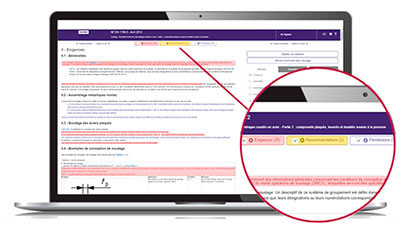
To comply with a standard, you need to quickly understand its issues in order to determine its impact on your activity.

The Requirements department helps you quickly locate within the normative text:
- mandatory clauses to satisfy,
- non-essential but useful clauses to know, such as permissions and recommendations.

The identification of these types of clauses is based on the document “ISO / IEC Directives, Part 2 - Principles and rules of structure and drafting of ISO documents ”as well as on a constantly enriched list of verbal forms.

With Requirements, quickly access the main part of the normative text!

With Requirements, quickly access the main part of the normative text!
Need to identify, monitor and decipher standards?

COBAZ is the simple and effective solution to meet the normative needs related to your activity, in France and abroad.

Available by subscription, CObaz is THE modular solution to compose according to your needs today and tomorrow. Quickly discover CObaz!

Request your free, no-obligation live demo

I discover COBAZ