ISO 18063-1:2016
ISO 18063-1:2016

ISO 18063-1:2016

November 2016
International standard Current

Rough-terrain trucks - Visibility - Test methods and their verification - Part 1: Variable-reach trucks

ISO 18063-1:2016 applies to rough-terrain variable-reach trucks (hereinafter referred to as ?trucks') that have a specific seated operator's position on the left-hand side of the boom or centre position (excluding operator position on the right side of the boom).ISO 18063-1:2016 specifies a static test method for determining and evaluating the operator's visibility on a rectangular 1 m boundary around the rough-terrain variable-reach truck and on a 12 m radius visibility test circle. Performance requirements for visibility are specified in this document.ISO 18063-1:2016 does not apply to- trucks designed to handle freight containers (reach stackers),- articulated telescopic wheel loaders,- slewing trucks, or- lorry mounted trucks.

View the extract
Main informations

Collections

International ISO standards

Publication date

November 2016

Number of pages

17 p.

Reference

ISO 18063-1:2016

ICS Codes

53.060   Industrial trucks

Print number

2 - février 2017
Sumary
Rough-terrain trucks - Visibility - Test methods and their verification - Part 1: Variable-reach trucks

ISO 18063-1:2016 applies to rough-terrain variable-reach trucks (hereinafter referred to as ?trucks') that have a specific seated operator's position on the left-hand side of the boom or centre position (excluding operator position on the right side of the boom).

ISO 18063-1:2016 specifies a static test method for determining and evaluating the operator's visibility on a rectangular 1 m boundary around the rough-terrain variable-reach truck and on a 12 m radius visibility test circle. Performance requirements for visibility are specified in this document.

ISO 18063-1:2016 does not apply to

- trucks designed to handle freight containers (reach stackers),

- articulated telescopic wheel loaders,

- slewing trucks, or

- lorry mounted trucks.

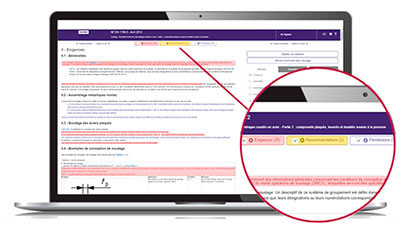
ZOOM ON ... the Requirements department

To comply with a standard, you need to quickly understand its issues in order to determine its impact on your activity.

The Requirements department helps you quickly locate within the normative text:

  • mandatory clauses to satisfy,
  • non-essential but useful clauses to know, such as permissions and recommendations.

The identification of these types of clauses is based on the document "ISO/IEC Directives, Part 2 - Principles and rules of structure and drafting of ISO documents" as well as on a constantly enriched list of verbal forms.

With Requirements, quickly access the main part of the normative text!


Need to identify, monitor and decipher standards?