ISO 182-3:2025
Plastics - Determination of the tendency of compounds and products based on vinyl chloride homopolymers and copolymers to evolve hydrogen chloride and any other acidic products at elevated temperatures - Part 3: Conductometric method
This document specifies a method for the determination of the thermal stability at elevated temperature of compounds and products based on vinyl chloride homopolymers and copolymers (in the following text abbreviated as PVC) which undergo dehydrochlorination (the evolution of hydrogen chloride).This document is applicable to the characterization of PVC compounds and products, especially with regard to the effectiveness of their heat-stabilizing systems.It is applicable to coloured PVC compounds and products where a discolouration test under the action of heat can be unsatisfactory.This document is applicable to compounded PVC materials and products. It can be applicable to polymers in powder form under appropriate conditions, depending on the agreement between the interested parties.This document does not apply to PVC compounds in the form of dry blends, since such materials might not be sufficiently homogeneous.This document does not apply to PVC compounds and products which evolve other decomposition products, in addition to hydrogen chloride, at elevated temperatures that can affect the conductivity of water when they are absorbed into it.NOTE In this case, ISO 182-4 [2] provides the suitable method for the determination of chloride ion (Cl−) in the absorbing solution.This document can also be applied to other plastics materials which can evolve hydrogen chloride or other hydrogen halides when heated under the conditions prescribed by the relevant specifications, or as agreed upon between the interested parties.

This document specifies a method for the determination of the thermal stability at elevated temperature of compounds and products based on vinyl chloride homopolymers and copolymers (in the following text abbreviated as PVC) which undergo dehydrochlorination (the evolution of hydrogen chloride).
This document is applicable to the characterization of PVC compounds and products, especially with regard to the effectiveness of their heat-stabilizing systems.
It is applicable to coloured PVC compounds and products where a discolouration test under the action of heat can be unsatisfactory.
This document is applicable to compounded PVC materials and products. It can be applicable to polymers in powder form under appropriate conditions, depending on the agreement between the interested parties.
This document does not apply to PVC compounds in the form of dry blends, since such materials might not be sufficiently homogeneous.
This document does not apply to PVC compounds and products which evolve other decomposition products, in addition to hydrogen chloride, at elevated temperatures that can affect the conductivity of water when they are absorbed into it.
NOTE In this case, ISO 182-4 [2] provides the suitable method for the determination of chloride ion (Cl−) in the absorbing solution.
This document can also be applied to other plastics materials which can evolve hydrogen chloride or other hydrogen halides when heated under the conditions prescribed by the relevant specifications, or as agreed upon between the interested parties.
This document specifies a method for the determination of the thermal stability at elevated temperature of compounds and products based on vinyl chloride homopolymers and copolymers (in the following text abbreviated as PVC) which undergo dehydrochlorination (the evolution of hydrogen chloride). This document is applicable to the characterization of PVC compounds and products, especially with regard to the effectiveness of their heat-stabilizing systems. It is applicable to coloured PVC compounds and products where a discolouration test under the action of heat may be unsatisfactory. This document is applicable to compounded PVC materials and products. It can be applicable to polymers in powder form under appropriate conditions, to be agreed upon between the interested parties. This document does not apply to PVC compounds in the form of dry blends, since such materials can be not sufficiently homogeneous. This document does not apply to PVC compounds and products which evolve other decomposition products, in addition to hydrogen chloride, at elevated temperatures that can affect the conductivity of water when they are absorbed into it. In this case, a method suitable for the determination of chloride ion (Cl−) in the absorbing solution shall be used (see ISO 182-4[2]). This document can also be applied to other plastics materials which can evolve hydrogen chloride or other hydrogen halides when heated under the conditions prescribed by the relevant specifications, or as agreed upon between the interested parties.
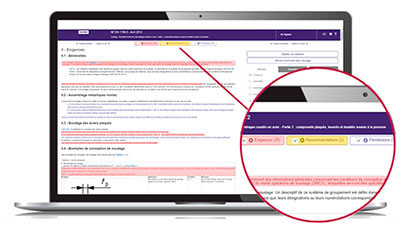
The Requirements department helps you quickly locate within the normative text:
- mandatory clauses to satisfy,
- non-essential but useful clauses to know, such as permissions and recommendations.
The identification of these types of clauses is based on the document “ISO / IEC Directives, Part 2 - Principles and rules of structure and drafting of ISO documents ”as well as on a constantly enriched list of verbal forms.
With Requirements, quickly access the main part of the normative text!

At a glance, you will be able to identify the additions, deletions or modifications to a text, table, figure and formula.

The Redlines + service is offered to you on the collection of French standards in force, in French language and in HTML and PDF format.
For an overview of the service, click on View a standard in redline format
COBAZ is the simple and effective solution to meet the normative needs related to your activity, in France and abroad.
Available by subscription, CObaz is THE modular solution to compose according to your needs today and tomorrow. Quickly discover CObaz!
Request your free, no-obligation live demo
I discover COBAZ