ISO 19581:2025

ISO 19581:2025

September 2025
International standard Current

Measurement of radioactivity - Gamma emitting radionuclides - Rapid screening method using scintillation detector gamma-ray spectrometry

This document specifies a screening test method to quantify rapidly the activity concentration of gamma-emitting radionuclides, such as 131I, 132Te, 134Cs and 137Cs, in solid or liquid test samples using gamma-ray spectrometry with lower resolution scintillation detectors as compared with the HPGe detectors (see IEC 61563[7]).This test method can be used for the measurement of any potentially contaminated environmental matrices (including soil), food and feed samples as well as industrial materials or products that have been properly conditioned[8]. Sample preparation techniques used in the screening method are not specified in this document, since special sample preparation techniques other than simple machining (cutting, grinding, etc.) should not be required. Although the sampling procedure is of utmost importance in the case of the measurement of radioactivity in samples, it is out of scope of this document; other International Standards for sampling procedures that can be used in combination with this document are available (see References [9] [10] [11] [12] [13] [14]).The test method applies to the measurement of gamma-emitting radionuclides such as 131I, 134Cs and 137Cs. Using sample sizes of 0,5 l to 1,0 l in a Marinelli beaker and a counting time of 5 min to 20 min, decision threshold of 10 Bq·kg−1 can be achievable using a commercially available scintillation spectrometer [e.g. thallium activated sodium iodide (NaI(Tl)) spectrometer 2” ϕ × 2” (50,8 mm Ø x 50,8 mm) detector size, 7 % resolution (FWHM) at 662 keV, 30 mm lead shield thickness].This test method also can be performed in a “makeshift” laboratory or even outside a testing laboratory on samples directly measured in the field where they were collected.During a nuclear or radiological emergency, this test method enables a rapid measurement of the activity concentration of potentially contaminated samples to check against operational intervention levels (OILs) set up by decision makers that would trigger a predetermined emergency response to reduce existing radiation risks[2].Due to the uncertainty associated with the results obtained with this test method, test samples requiring more accurate test results can be measured using high purity germanium (HPGe) detectors gamma-ray spectrometry in a testing laboratory, following appropriate preparation of the test samples[15][16].This document does not contain criteria to establish the activity concentration of OILs.

View the extract
Main informations

Collections

International ISO standards

Publication date

September 2025

Number of pages

22 p.

Reference

ISO 19581:2025

ICS Codes

17.240   Radiation measurements

Print number

1
Sumary
Measurement of radioactivity - Gamma emitting radionuclides - Rapid screening method using scintillation detector gamma-ray spectrometry

This document specifies a screening test method to quantify rapidly the activity concentration of gamma-emitting radionuclides, such as 131I, 132Te, 134Cs and 137Cs, in solid or liquid test samples using gamma-ray spectrometry with lower resolution scintillation detectors as compared with the HPGe detectors (see IEC 61563[7]).

This test method can be used for the measurement of any potentially contaminated environmental matrices (including soil), food and feed samples as well as industrial materials or products that have been properly conditioned[8]. Sample preparation techniques used in the screening method are not specified in this document, since special sample preparation techniques other than simple machining (cutting, grinding, etc.) should not be required. Although the sampling procedure is of utmost importance in the case of the measurement of radioactivity in samples, it is out of scope of this document; other International Standards for sampling procedures that can be used in combination with this document are available (see References [9] [10] [11] [12] [13] [14]).

The test method applies to the measurement of gamma-emitting radionuclides such as 131I, 134Cs and 137Cs. Using sample sizes of 0,5 l to 1,0 l in a Marinelli beaker and a counting time of 5 min to 20 min, decision threshold of 10 Bq·kg−1 can be achievable using a commercially available scintillation spectrometer [e.g. thallium activated sodium iodide (NaI(Tl)) spectrometer 2” ϕ × 2” (50,8 mm Ø x 50,8 mm) detector size, 7 % resolution (FWHM) at 662 keV, 30 mm lead shield thickness].

This test method also can be performed in a “makeshift” laboratory or even outside a testing laboratory on samples directly measured in the field where they were collected.

During a nuclear or radiological emergency, this test method enables a rapid measurement of the activity concentration of potentially contaminated samples to check against operational intervention levels (OILs) set up by decision makers that would trigger a predetermined emergency response to reduce existing radiation risks[2].

Due to the uncertainty associated with the results obtained with this test method, test samples requiring more accurate test results can be measured using high purity germanium (HPGe) detectors gamma-ray spectrometry in a testing laboratory, following appropriate preparation of the test samples[15][16].

This document does not contain criteria to establish the activity concentration of OILs.

Replaced standards (1)
ISO 19581:2017
October 2017
International standard Cancelled
Measurement of radioactivity - Gamma emitting radionuclides - Rapid screening method using scintillation detector gamma-ray spectrometry

ISO 19581 specifies a screening test method to quantify rapidly the activity concentration of gamma-emitting radionuclides, such as 131I, 132Te, 134Cs and 137Cs, in solid or liquid test samples using gamma-ray spectrometry with lower resolution scintillation detectors as compared with the HPGe detectors (see IEC 61563). This test method can be used for the measurement of any potentially contaminated environmental matrices (including soil), food and feed samples as well as industrial materials or products that have been properly conditioned. Sample preparation techniques used in the screening method are not specified in ISO 19581, since special sample preparation techniques other than simple machining (cutting, grinding, etc.) should not be required. Although the sampling procedure is of utmost importance in the case of the measurement of radioactivity in samples, it is out of scope of ISO 19581; other international standards for sampling procedures that can be used in combination with ISO 19581 are available (see References [1],[2],[3],[4],[5],[6]). The test method applies to the measurement of gamma-emitting radionuclides such as 131I, 134Cs and 137Cs. Using sample sizes of 0,5 l to 1,0 l in a Marinelli beaker and a counting time of 5 min to 20 min, decision threshold of 10 Bq·kg−1 can be achievable using a commercially available scintillation spectrometer [e.g. thallium activated sodium iodine (NaI(Tl)) spectrometer 2" ϕ × 2" detector size, 7 % resolution (FWHM) at 662 keV, 30 mm lead shield thickness]. This test method also can be performed in a "makeshift" laboratory or even outside a testing laboratory on samples directly measured in the field where they were collected. During a nuclear or radiological emergency, this test method enables a rapid measurement of the sample activity concentration of potentially contaminated samples to check against operational intervention levels (OILs) set up by decision makers that would trigger a predetermined emergency response to reduce existing radiation risks[12]. Due to the uncertainty associated with the results obtained with this test method, test samples requiring more accurate test results can be measured using high-purity germanium (HPGe) detectors gamma-ray spectrometry in a testing laboratory, following appropriate preparation of the test samples[7][8]. ISO 19581 does not contain criteria to establish the activity concentration of OILs.

ZOOM ON ... the Requirements department
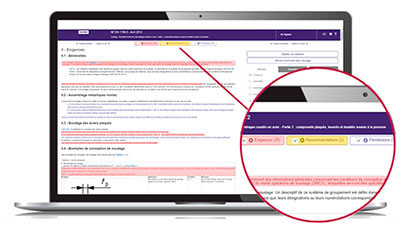
To comply with a standard, you need to quickly understand its issues in order to determine its impact on your activity.

The Requirements department helps you quickly locate within the normative text:
- mandatory clauses to satisfy,
- non-essential but useful clauses to know, such as permissions and recommendations.

The identification of these types of clauses is based on the document “ISO / IEC Directives, Part 2 - Principles and rules of structure and drafting of ISO documents ”as well as on a constantly enriched list of verbal forms.

With Requirements, quickly access the main part of the normative text!

With Requirements, quickly access the main part of the normative text!
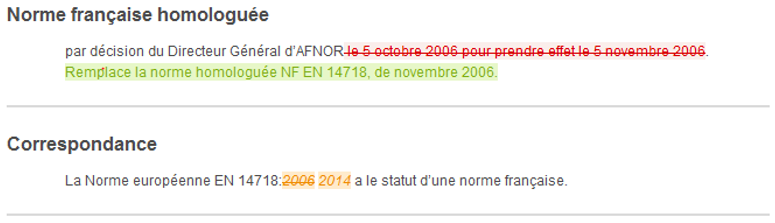
What is the Redline format?
The Redline + service - standards comparator allows you to easily and simply identify major changes between the current standard and its last canceled version.

At a glance, you will be able to identify the additions, deletions or modifications to a text, table, figure and formula.
At a glance, you will be able to identify the additions, deletions or modifications to a text, table, figure and formula

The Redlines + service is offered to you on the collection of French standards in force, in French language and in HTML and PDF format.

For an overview of the service, click on View a standard in redline format
Need to identify, monitor and decipher standards?

COBAZ is the simple and effective solution to meet the normative needs related to your activity, in France and abroad.

Available by subscription, CObaz is THE modular solution to compose according to your needs today and tomorrow. Quickly discover CObaz!

Request your free, no-obligation live demo

I discover COBAZ