ISO 20674-1:2019
ISO 20674-1:2019

ISO 20674-1:2019

October 2019
International standard Current

Information and documentation - Transliteration of scripts in use in Thailand - Part 1: Transliteration of Akson-Thai-Noi

This document describes the orthographic system of the Akson-Thai-Noi script using Romanized characters.This document can be used by anyone who has a clear understanding of the system and is certain that it can be applied without ambiguity. The result obtained will not give a correct pronunciation of the original text in a person's own language, but it will serve as a means of finding automatically the original graphism and thus allow anyone who has a knowledge of the original language to pronounce it correctly.NOTE Similarly, one can only pronounce correctly a text written in, for example, English or Polish, if one has a knowledge of English or Polish.


View the extract
Main informations

Collections

International ISO standards

Publication date

October 2019

Number of pages

14 p.

Reference

ISO 20674-1:2019

ICS Codes

01.140.10   Writing and transliteration

Print number

1
Sumary
Information and documentation - Transliteration of scripts in use in Thailand - Part 1: Transliteration of Akson-Thai-Noi

This document describes the orthographic system of the Akson-Thai-Noi script using Romanized characters.

This document can be used by anyone who has a clear understanding of the system and is certain that it can be applied without ambiguity. The result obtained will not give a correct pronunciation of the original text in a person's own language, but it will serve as a means of finding automatically the original graphism and thus allow anyone who has a knowledge of the original language to pronounce it correctly.

NOTE Similarly, one can only pronounce correctly a text written in, for example, English or Polish, if one has a knowledge of English or Polish.
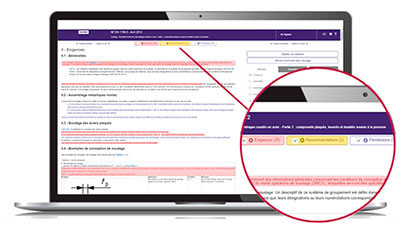
ZOOM ON ... the Requirements department

To comply with a standard, you need to quickly understand its issues in order to determine its impact on your activity.

The Requirements department helps you quickly locate within the normative text:

  • mandatory clauses to satisfy,
  • non-essential but useful clauses to know, such as permissions and recommendations.

The identification of these types of clauses is based on the document "ISO/IEC Directives, Part 2 - Principles and rules of structure and drafting of ISO documents" as well as on a constantly enriched list of verbal forms.

With Requirements, quickly access the main part of the normative text!


Need to identify, monitor and decipher standards?