ISO 21719-1:2026
ISO 21719-1:2026

ISO 21719-1:2026

March 2026
International standard Current

Electronic fee collection — Personalization of on-board equipment (OBE) — Part 1: Framework

This document establishes a framework and specifies electronic fee collection (EFC) functions for the personalization process of on-board equipment (OBE) used for EFC.The personalization process takes place within the domain of the entity that is responsible for the application in the OBE.This document is applicable to the EFC interface, e.g. using dedicated short-range communication or integrated circuit(s) card, between the personalization equipment (PE) and OBE as shown in Figure 1.This document does not cover the following:whether the personalization functionality resides completely in the PE or whether this functionality instead resides in a central system, where the PE is more or less “transparent”;the exact application command or message structures for the EFC personalization functionality (these are dependent on the communication media and are described in subsequent parts of the ISO 21719 series);the test procedures for evaluation of an implementation for conformity to the requirements in this document;setting-up of operating organizations (e.g. toll service provider, personalization agent, trusted third party).NOTE            Some of the issues listed above are subject to separate documents prepared by ISO/TC 204, CEN/TC 278 and the European Telecommunications Standards Institute – Electromagnetic compatibility and Radio Spectrum Matters (ETSI ERM).


View the extract
Main informations

Collections

International ISO standards

Thematics

Management et performance

Publication date

March 2026

Number of pages

8 p.

Reference

ISO 21719-1:2026

ICS Codes

03.220.20   Road transport
35.240.60   IT applications in transport

Print number

1
Sumary
Electronic fee collection — Personalization of on-board equipment (OBE) — Part 1: Framework

This document establishes a framework and specifies electronic fee collection (EFC) functions for the personalization process of on-board equipment (OBE) used for EFC.

The personalization process takes place within the domain of the entity that is responsible for the application in the OBE.

This document is applicable to the EFC interface, e.g. using dedicated short-range communication or integrated circuit(s) card, between the personalization equipment (PE) and OBE as shown in Figure 1.

This document does not cover the following:

  • whether the personalization functionality resides completely in the PE or whether this functionality instead resides in a central system, where the PE is more or less “transparent”;
  • the exact application command or message structures for the EFC personalization functionality (these are dependent on the communication media and are described in subsequent parts of the ISO 21719 series);
  • the test procedures for evaluation of an implementation for conformity to the requirements in this document;
  • setting-up of operating organizations (e.g. toll service provider, personalization agent, trusted third party).

NOTE            Some of the issues listed above are subject to separate documents prepared by ISO/TC 204, CEN/TC 278 and the European Telecommunications Standards Institute – Electromagnetic compatibility and Radio Spectrum Matters (ETSI ERM).
Replaced standards (1)
ISO/TS 21719-1:2018
ISO/TS 21719-1:2018
January 2018
Technical specification Cancelled
Electronic fee collection — Personalization of on-board equipment (OBE) — Part 1: Framework

ISO/TS 21719-1:2018 describes: - an overall description of the EFC personalization process; - a description of EFC functionality that can be used for personalization. The personalization process takes place within the domain of the entity that is responsible for the application in the OBE.

ZOOM ON ... the Requirements department
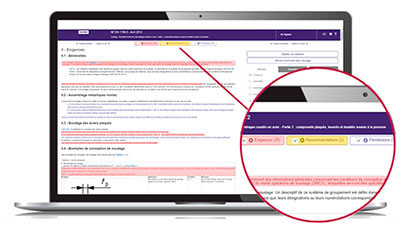
To comply with a standard, you need to quickly understand its issues in order to determine its impact on your activity.

The Requirements department helps you quickly locate within the normative text:
- mandatory clauses to satisfy,
- non-essential but useful clauses to know, such as permissions and recommendations.

The identification of these types of clauses is based on the document “ISO / IEC Directives, Part 2 - Principles and rules of structure and drafting of ISO documents ”as well as on a constantly enriched list of verbal forms.

With Requirements, quickly access the main part of the normative text!

With Requirements, quickly access the main part of the normative text!
What is the Redline format?
Need to identify, monitor and decipher standards?