ISO 22477-6:2026
ISO 22477-6:2026

ISO 22477-6:2026

March 2026
International standard Current

Geotechnical investigation and testing — Testing of geotechnical structures — Part 6: Load testing of soil nails and rock bolts

This document establishes the specifications for the execution of tension tests to be carried out on soil nails and rock bolts.NOTE 1      Soil nails and rock bolts are referred to as elements in the scope of this document.NOTE 2      This document covers but is not limited to grouted soil nails and rock bolts.NOTE 3      This document does not provide specification for the number of tests, the type of test, the Test Method, the value of the proof load and the limiting criteria. These aspects reside in EN 1997-3 and its national annex or in similar standards.This document provides specifications for three types of tension tests: investigation tests, suitability tests and acceptance tests.Two methods of testing are recognised by this document. Test Method A involves step-loaded maintained load tension tests. Test Method B involves constant displacement rate tension tests.This document provides specifications for the experimental devices, the measurement apparatus, the test procedures, the definition and the presentation of the test results and the content of records, aiming at:a)      measuring the pull-out resistance of a soil nail or a rock bolt;NOTE 4      A loading test performed using this document provides the pulled-out resistance along the bonded length, that will possibly differ from the pull-out resistance considered in design.b)      checking that a soil nail or rock bolt behaves as designed.

View the extract
Main informations

Collections

International ISO standards

Publication date

March 2026

Number of pages

19 p.

Reference

ISO 22477-6:2026

ICS Codes

93.020   Earthworks. Excavations. Foundation construction. Underground works

Print number

1
Sumary
Geotechnical investigation and testing — Testing of geotechnical structures — Part 6: Load testing of soil nails and rock bolts

This document establishes the specifications for the execution of tension tests to be carried out on soil nails and rock bolts.

NOTE 1      Soil nails and rock bolts are referred to as elements in the scope of this document.

NOTE 2      This document covers but is not limited to grouted soil nails and rock bolts.

NOTE 3      This document does not provide specification for the number of tests, the type of test, the Test Method, the value of the proof load and the limiting criteria. These aspects reside in EN 1997-3 and its national annex or in similar standards.

This document provides specifications for three types of tension tests: investigation tests, suitability tests and acceptance tests.

Two methods of testing are recognised by this document. Test Method A involves step-loaded maintained load tension tests. Test Method B involves constant displacement rate tension tests.

This document provides specifications for the experimental devices, the measurement apparatus, the test procedures, the definition and the presentation of the test results and the content of records, aiming at:

a)      measuring the pull-out resistance of a soil nail or a rock bolt;

NOTE 4      A loading test performed using this document provides the pulled-out resistance along the bonded length, that will possibly differ from the pull-out resistance considered in design.

b)      checking that a soil nail or rock bolt behaves as designed.

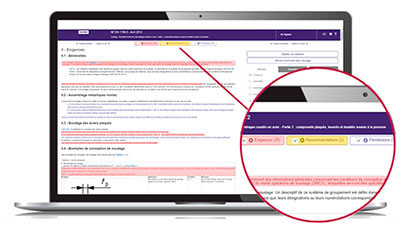
ZOOM ON ... the Requirements department

To comply with a standard, you need to quickly understand its issues in order to determine its impact on your activity.

The Requirements department helps you quickly locate within the normative text:

  • mandatory clauses to satisfy,
  • non-essential but useful clauses to know, such as permissions and recommendations.

The identification of these types of clauses is based on the document "ISO/IEC Directives, Part 2 - Principles and rules of structure and drafting of ISO documents" as well as on a constantly enriched list of verbal forms.

With Requirements, quickly access the main part of the normative text!


Need to identify, monitor and decipher standards?