ISO 22915-20:2023
Industrial trucks - Verification of stability - Part 20: Additional stability test for trucks operating in the special condition of offset load, offset by utilization
This document specifies an additional test for verifying the stability of a laden truck whose utilization creates the special operating condition whereby the load centre of gravity is substantially offset from the truck's longitudinal centre plane or from the centred position by design.A load is considered to be substantially offset if displaced by more than:— 100 mm, for a truck with a rated capacity < 5 000 kg;— 150 mm, for a truck with a rated capacity ≥ 5 000 kg and ≤ 10 000 kg;— 250 mm, for a truck with a rated capacity > 10 000 kg and < 20 000 kg;— 350 mm, for a truck with a rated capacity ≥ 20 000 kg.This document is applicable to the following types of trucks as defined in ISO 5053-1:a) counterbalance trucks;b) reach and straddle trucks;c) pallet stackers;d) bidirectional and multidirectional trucks;e) industrial variable-reach trucks;f) rough-terrain trucks with mast;g) rough-terrain variable reach trucks;h) counterbalance trucks with articulated steering;i) variable-reach container handler;j) counterbalanced container handler;k) order-picking truck;l) slewing rough-terrain variable-reach truck.
This document specifies an additional test for verifying the stability of a laden truck whose utilization creates the special operating condition whereby the load centre of gravity is substantially offset from the truck's longitudinal centre plane or from the centred position by design.
A load is considered to be substantially offset if displaced by more than:
— 100 mm, for a truck with a rated capacity < 5 000 kg;
— 150 mm, for a truck with a rated capacity ≥ 5 000 kg and ≤ 10 000 kg;
— 250 mm, for a truck with a rated capacity > 10 000 kg and < 20 000 kg;
— 350 mm, for a truck with a rated capacity ≥ 20 000 kg.
This document is applicable to the following types of trucks as defined in ISO 5053-1:
a) counterbalance trucks;
b) reach and straddle trucks;
c) pallet stackers;
d) bidirectional and multidirectional trucks;
e) industrial variable-reach trucks;
f) rough-terrain trucks with mast;
g) rough-terrain variable reach trucks;
h) counterbalance trucks with articulated steering;
i) variable-reach container handler;
j) counterbalanced container handler;
k) order-picking truck;
l) slewing rough-terrain variable-reach truck.
ISO 22915 deals with the safety of industrial trucks, as defined in ISO 5053, relative to their stability and the verification of that stability. For the purposes of ISO 22915, industrial trucks are wheeled, self‑propelled or pedestrian‑propelled vehicles, excepting those running on rails. They are either operator‑controlled or driverless and designed to carry, tow, push, lift, stack or tier in racks. ISO 22915-20:2008 specifies an additional test for verifying the stability of a laden truck specifies an additional test for verifying the stability of a laden truck whose utilization creates the special operating condition whereby the load centre of gravity is substantially offset from the truck's longitudinal centre plane. It is applicable to the following types of truck: It is applicable to the following types of truck: counterbalanced trucks; reach (retractable mast or forks) and straddle trucks; pallet stackers; bi‑directional and multi‑directional (retractable mast or forks) trucks; rough-terrain variable reach trucks; counterbalanced trucks fitted with articulated steering; variable reach trucks; rough terrain trucks with mast. A load is considered to be substantially offset if displaced by more than 100 mm, for a truck with a rated capacity less than 5 000 kg, 150 mm, for a truck with a rated capacity greater than or equal to 5 000 kg and less than or equal to 10 000 kg, 250 mm, for a truck with a rated capacity greater than 10 000 kg and less than 20 000 kg, 350 mm, for a truck with a rated capacity greater than or equal to 20 000 kg.
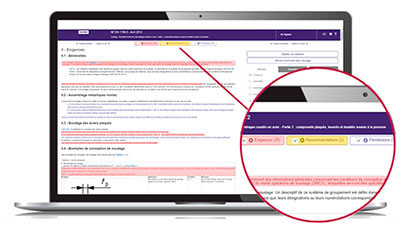
The Requirements department helps you quickly locate within the normative text:
- mandatory clauses to satisfy,
- non-essential but useful clauses to know, such as permissions and recommendations.
The identification of these types of clauses is based on the document “ISO / IEC Directives, Part 2 - Principles and rules of structure and drafting of ISO documents ”as well as on a constantly enriched list of verbal forms.
With Requirements, quickly access the main part of the normative text!

COBAZ is the simple and effective solution to meet the normative needs related to your activity, in France and abroad.
Available by subscription, CObaz is THE modular solution to compose according to your needs today and tomorrow. Quickly discover CObaz!
Request your free, no-obligation live demo
I discover COBAZ