ISO 24024-1:2021
Plastics — Homopolymer and copolymer resins of vinyl chloride — Part 1: Designation system and basis for specifications
1.1 This document establishes a system of designation for vinyl chloride thermoplastic resins which can be used as the basis for specifications.1.2 The types of vinyl chloride plastics are differentiated from each other by a classification system based on appropriate levels of the designatory properties:a) reduced viscosity;b) apparent density;c) retention on a 63 µm mesh sieve;d) plasticizer absorption at room temperature (for general-purpose resins);e) the viscosity and the type of rheological behaviour of a standard paste (for paste resins only);and on information about basic polymer parameters, polymerization processes and intended applications.1.3 This document is applicable to resins in powder form which consist of homopolymers of the monomer vinyl chloride and copolymers, terpolymers, etc., of vinyl chloride with one or more other monomers, but where vinyl chloride is the main constituent. The resins can contain small amounts of non-polymerized substances (e.g. emulsifying or suspending agents, catalyst residues, etc.) and other substances added during the course of polymerization.1.4 It is not intended to imply that materials having the same designation give necessarily the same performance. This document does not provide engineering data, performance data or data on processing conditions which can be required to specify a material for a particular application and/or method of processing.If such additional properties are required, they are determined in accordance with the test methods specified in ISO 24024-2, if suitable.1.5 In order to specify a resin for a particular application or to ensure reproducible processing, additional requirements can be given in data block 5 (see 4.1).
1.1 This document establishes a system of designation for vinyl chloride thermoplastic resins which can be used as the basis for specifications.
1.2 The types of vinyl chloride plastics are differentiated from each other by a classification system based on appropriate levels of the designatory properties:
a) reduced viscosity;
b) apparent density;
c) retention on a 63 µm mesh sieve;
d) plasticizer absorption at room temperature (for general-purpose resins);
e) the viscosity and the type of rheological behaviour of a standard paste (for paste resins only);
and on information about basic polymer parameters, polymerization processes and intended applications.
1.3 This document is applicable to resins in powder form which consist of homopolymers of the monomer vinyl chloride and copolymers, terpolymers, etc., of vinyl chloride with one or more other monomers, but where vinyl chloride is the main constituent. The resins can contain small amounts of non-polymerized substances (e.g. emulsifying or suspending agents, catalyst residues, etc.) and other substances added during the course of polymerization.
1.4 It is not intended to imply that materials having the same designation give necessarily the same performance. This document does not provide engineering data, performance data or data on processing conditions which can be required to specify a material for a particular application and/or method of processing.
If such additional properties are required, they are determined in accordance with the test methods specified in ISO 24024-2, if suitable.
1.5 In order to specify a resin for a particular application or to ensure reproducible processing, additional requirements can be given in data block 5 (see 4.1).
La présente partie de l'ISO 1060 établit un système de désignation des résines thermoplastiques à base de chlorure de vinyle qui peut être utilisé comme base pour les spécifications. Les types de plastiques à base de chlorure de vinyle sont différenciés les uns des autres par un système de classification basé sur des niveaux appropriés des propriétés de désignation : a) viscosité réduite ; b) masse volumique apparente ; c) refus sur tamis de 63 pm d'ouverture de maille ; d) prise de plastifiant à la température ambiante (pour les résines pour usages généraux et les résines chargées, uniquement) ; e) viscosité et type de comportement rhéologique d'une pâte normalisée (pour les résines sous forme de pâtes, uniquement) ; et sur des informations concernant certains paramètres relatifs au polymère de base, les procédés de polymérisation et l'application prévue.
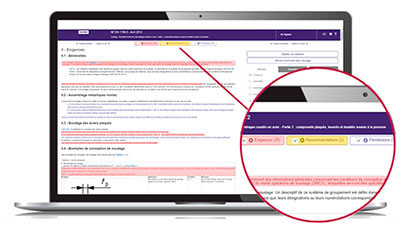
The Requirements department helps you quickly locate within the normative text:
- mandatory clauses to satisfy,
- non-essential but useful clauses to know, such as permissions and recommendations.
The identification of these types of clauses is based on the document “ISO / IEC Directives, Part 2 - Principles and rules of structure and drafting of ISO documents ”as well as on a constantly enriched list of verbal forms.
With Requirements, quickly access the main part of the normative text!

COBAZ is the simple and effective solution to meet the normative needs related to your activity, in France and abroad.
Available by subscription, CObaz is THE modular solution to compose according to your needs today and tomorrow. Quickly discover CObaz!
Request your free, no-obligation live demo
I discover COBAZ