ISO 24617-4:2014
ISO 24617-4:2014

ISO 24617-4:2014

July 2014
International standard Current

Language resource management — Semantic annotation framework (SemAF) — Part 4: Semantic roles (SemAF-SR)

The aim of ISO 24617-4:2014 is to propose a consensual annotation scheme for semantic roles; that is to say, a scheme that indicates the role that a participant plays in an event or state, as described mostly by a verb, and typically providing answers to questions such as "?who' did ?what' to ?whom'", and ?when', ?where', ?why', and ?how'. This includes not only the semantic relations between a verb and its arguments but also those relations that are relevant for other predicative elements such as nominalizations, nouns, adjectives, and predicate modifiers; the predicating role of adverbs and the use of coercion fall outside the scope of ISO 24617-4:2014.


View the extract
Main informations

Collections

International ISO standards

Publication date

July 2014

Number of pages

45 p.

Reference

ISO 24617-4:2014

ICS Codes

01.020   Terminology (principles and coordination)

Print number

1
Sumary
Language resource management — Semantic annotation framework (SemAF) — Part 4: Semantic roles (SemAF-SR)

The aim of ISO 24617-4:2014 is to propose a consensual annotation scheme for semantic roles; that is to say, a scheme that indicates the role that a participant plays in an event or state, as described mostly by a verb, and typically providing answers to questions such as "?who' did ?what' to ?whom'", and ?when', ?where', ?why', and ?how'. This includes not only the semantic relations between a verb and its arguments but also those relations that are relevant for other predicative elements such as nominalizations, nouns, adjectives, and predicate modifiers; the predicating role of adverbs and the use of coercion fall outside the scope of ISO 24617-4:2014.
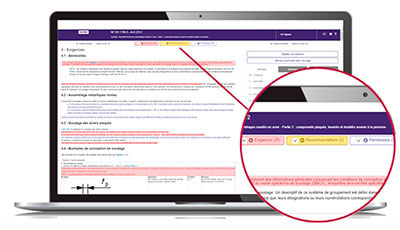
ZOOM ON ... the Requirements department

To comply with a standard, you need to quickly understand its issues in order to determine its impact on your activity.

The Requirements department helps you quickly locate within the normative text:

  • mandatory clauses to satisfy,
  • non-essential but useful clauses to know, such as permissions and recommendations.

The identification of these types of clauses is based on the document "ISO/IEC Directives, Part 2 - Principles and rules of structure and drafting of ISO documents" as well as on a constantly enriched list of verbal forms.

With Requirements, quickly access the main part of the normative text!


Need to identify, monitor and decipher standards?